

Event managers handle budgets that often run into six figures, juggle a dozen vendors, and absorb every problem before it reaches the C-suite.
But the difference between getting promoted and staying stuck rarely comes down to a bigger budget. It comes down to which skills leadership actually sees.
The U.S. Bureau of Labor Statistics projects 5% growth for meeting, convention, and event planners from 2024 to 2034 (faster than the average for all occupations), with about 15,500 openings every year (U.S. Bureau of Labor Statistics, May 2024).
The field held 155,800 jobs in 2024 with a median annual wage of $59,440. More openings mean more competition for the senior roles. Here’s how to stand out.

Key Takeaways
- Employer optimism for events hit a 5-year high in 2026, but 70% expect rising costs, meaning leadership rewards managers who deliver impact under tighter pressure (Amex GBT 2026 Global Meetings & Events Forecast).
- The skill that gets event managers promoted isn’t logistics; it’s tying every event to a business outcome leadership already cares about.
- Vendor selection is reputation insurance. The food, the venue, the AV: they’re all yours to defend in the post-event review.
- Post-event ROI reporting is the single most under-used career accelerator in event management.
What Skills Do Employers Actually Value in 2026?
In 2026, employers want event managers who think like business analysts and execute as operations leads.
According to the Amex GBT 2026 Global Meetings & Events Forecast, 85% of meeting professionals are optimistic about the year ahead, but more than 70% expect costs to rise, and 50% are integrating AI throughout event planning.
That puts a premium on managers who combine financial acumen, data literacy, and clear communication with the strategic ability to defend every dollar spent.
The technical skills now table-stakes: hybrid event platforms, project management software, and contract negotiation.
The strategic skills that get noticed are different. They include translating event goals into business KPIs, communicating up to leadership in their language, managing risk before it surfaces, and proving ROI after the lights come down.
Industry research from Event School London identifies five skill clusters that separate strong event managers from average ones in 2025 (Event School London, December 2024).
Those clusters: technological proficiency, sustainability and environmental awareness, adaptability and crisis management, data-driven decision-making, and people-centric leadership.
Notice what’s not on that list: being good at logistics. Logistics are assumed. What employers reward is judgment.
Want the shortcut? Pick one business outcome (pipeline created, employees retained, partners signed) and design every choice around it.
If you handle corporate events in Central Minnesota, the difference between a forgettable Q3 meeting and a memorable one often comes down to your corporate event catering partner, the vendor whose work is on every plate in the room.
How Do You Plan Events That Get Noticed by Leadership?
You get noticed by tying every event to a business outcome that leadership already cares about. The Amex GBT 2026 forecast reports that “memorable attendee experiences” topped the priority list for a second straight year.
But memorable to whom? Leadership doesn’t measure memory; they measure impact. Your job is to translate experience into impact before the event even happens.
The mistake most event managers make: they brief the CEO on logistics, such as where the venue is. What time does the bus leave? How many vendors confirmed? Leadership doesn’t care.
What they care about is whether the event will hit the number they’ve assigned to it: revenue, retention, recruiting, brand lift, whatever the metric is.
Frame every event around one business KPI
Before you write the run-of-show, write the impact statement. One sentence. “This sales kickoff will generate $X in committed pipeline within 30 days.” Or “This employee appreciation event will lift our Q3 engagement score by Y points.”
Then design every spend, every speaker, every minute of the agenda around that single metric.
According to Payscale data, the median corporate events manager salary in 2026 was around $65,000, but managers who get promoted into director roles consistently demonstrate they understand business outcomes, not just event logistics (Payscale, 2026).
The pay gap between a coordinator and a director is real. The mindset gap is what creates it.
Why Vendor Selection Decides Your Reputation
Your reputation rides on every vendor you choose, and the most visible one is almost always food. A late bus is forgivable. A speaker who runs long is fixable.
But cold buffets, missing dietary options, or a caterer who can’t set up on time? That’s what attendees remember, what surveys flag, and what leadership hears about Monday morning.

This is where the “vendor mistakes” trap catches new event managers. They pick the cheapest catering quote, the friendliest venue, the most local AV company, and only realize after the event that price was the wrong selection criterion.
The right criterion is risk reduction. Pick the vendor who removes the most things from your worry list.
What to actually look for in a corporate catering partner
From the catering side, the corporate event managers who run the smoothest events all do the same five things when vetting us:
- They ask about setup and teardown. If you have to coordinate those separately, you’ve added two more vendors to manage.
- They ask about dietary accommodations upfront. Not on event day. Vegetarian, gluten-free, halal, kosher: confirm the menu can flex before you sign.
- They ask about contingency. What happens if a delivery truck breaks down? Real catering operations have backup logistics; weekend hobbyists don’t.
- They ask for references for similar event sizes. Catering a 30-person lunch is different from feeding 500 at a quarterly kickoff. Track record matters.
- They ask about pricing transparency. Per head, with what is included? Hidden fees are the #1 reason event budgets blow up.
If you’re planning a corporate event in Central Minnesota and want a partner that handles setup, teardown, and dietary flexibility without surprises, our corporate catering service starts at $15 per head.
Those packages are designed around the things that actually break corporate events.
How to Master Budget Control Without Cutting Quality
Budget surprises end careers in event management. According to the Amex GBT 2026 Forecast, 28% of meeting professionals plan to reduce food and beverage spend in 2026, specifically because of cost pressure.
But the smart ones aren’t cutting quality; they’re shifting format. Drop-off catering instead of full-service. Lunch instead of dinner. Two entrée choices instead of four.
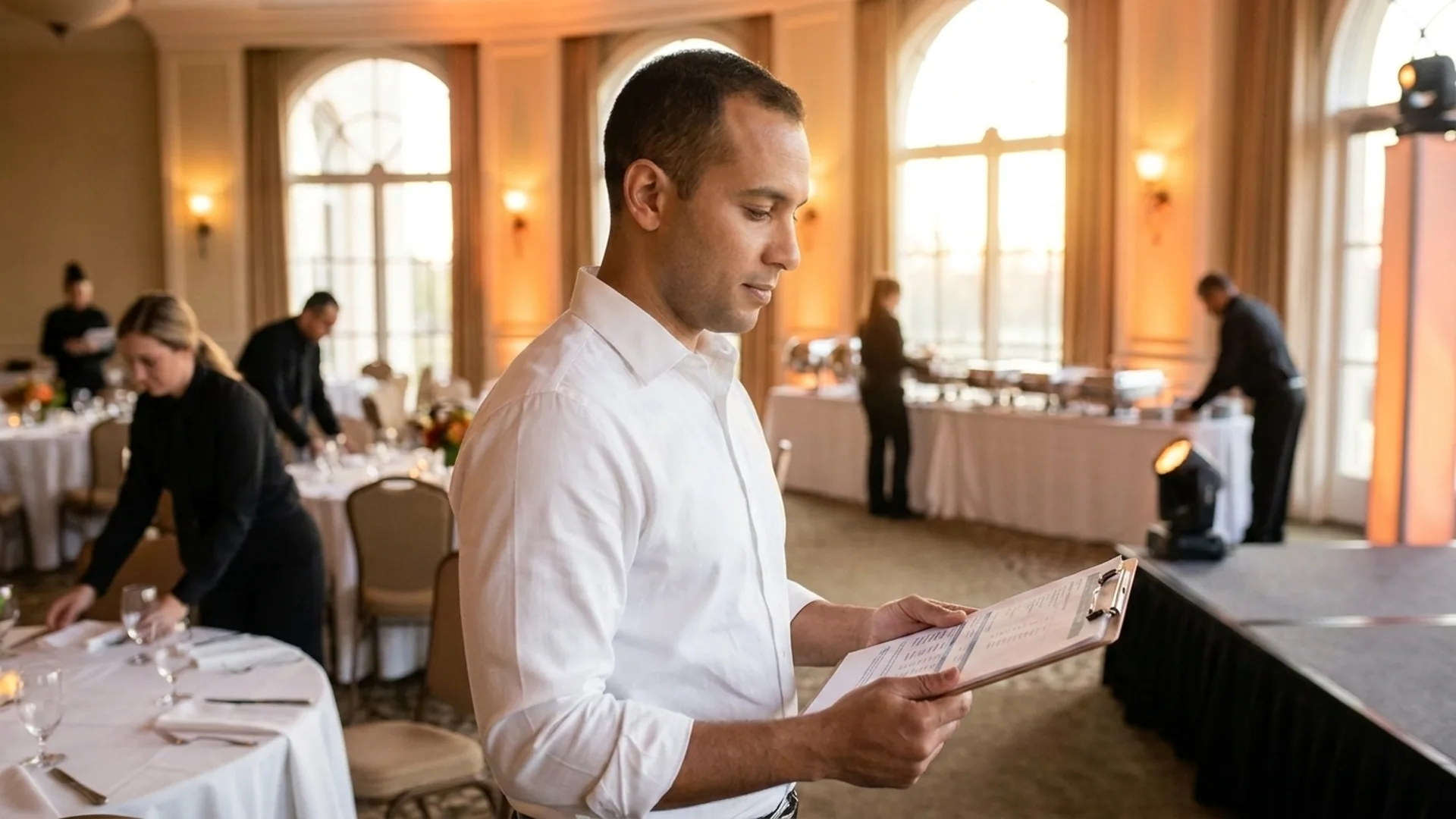
The framework that works: separate fixed costs from flexible costs before you negotiate anything. Fixed costs are the venue, the AV, and the speakers under contract. Those numbers don’t move.
Flexible costs are food, decor, swag, and transportation. Those are where you find your contingency.
Build the 10-15% contingency on day one
If your budget is $50,000, you don’t have $50,000 to spend. You have $42,500 to spend and $7,500 reserved for the things you can’t predict.
Last-minute attendee additions. A speaker who needs flights instead of driving. A vendor that hits you with a surcharge two weeks out.
Track every line item in real time, not on a spreadsheet you update weekly. The event managers who get blindsided by overruns are the ones who reconcile at the end. The ones who control budgets check daily during the final 30 days.
Lock catering pricing early. It’s one of the biggest line items and one of the easiest to control. Request a free catering estimate 8-12 weeks out, and you’ll have an accurate per-head number to defend in your budget review.
What Risk Management Skills Set You Apart?
Risk management in events is invisible when you do it well, which is precisely why employers undervalue it until something goes wrong.
The Amex GBT forecast lists “memorable attendee experiences” as the 2026 priority, but here’s the catch: nothing makes an event more memorable than a disaster. Your job is to make sure the only memorable thing is the good kind.
The risks corporate event managers most often miss come in three forms. First, weather contingencies for outdoor events, especially in Minnesota, where we’ve seen August graduation parties pivoted to indoor in 2 hours.
Then vendor backup plans (what if your AV company gets COVID 48 hours out?), and communication trees for last-minute changes.
Most event managers plan for the main case. The senior ones plan for the failure case.
Build a 3-deep contingency for every critical vendor
For your top three vendors (typically venue, catering, and AV), have a Plan B identified and quoted before signing your primary. Don’t wait until you need them.
Spend two hours during planning identifying who you’d call if your primary vendor backs out. Save those numbers. Don’t tell anyone you did it.
Then, two weeks before the event, do a final risk review with your team. Walk through everything that could go wrong. Assign each risk to one person whose only job is to monitor it.
This is the move that separates senior event managers from coordinators: not avoiding risk, but distributing accountability for it.
How Do You Prove ROI After the Event?
Post-event ROI reporting is the most underused career accelerator in event management. Most managers send a thank-you note and move to the next event.
The ones who get promoted produce a one-page report that quantifies the business impact and circulates it to leadership within 72 hours.
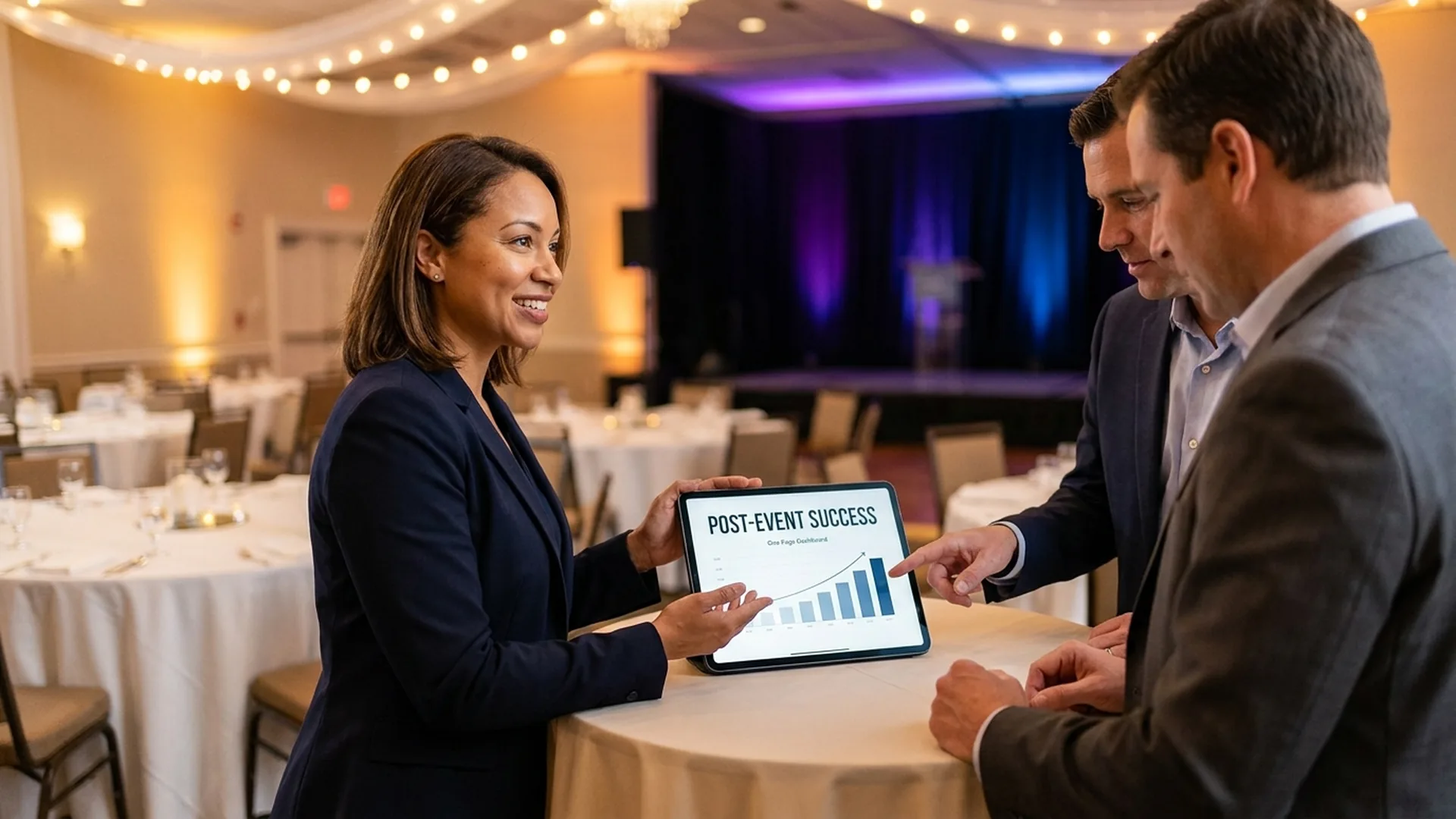
What goes in the report: attendance vs target, attendee satisfaction (NPS or 1-10 ratings), cost per attendee, business metric outcome (pipeline generated, deals advanced, retention impact), and three specific recommendations for next time.
Keep it short. Use visuals. Put the number that matters most in the headline.
Survey attendees within 48 hours, not next week
Response rates on event surveys drop off a cliff after 48 hours, once attendees return to their routines and lose the emotional connection to the experience (i4a). Send the survey while the event is still memorable, keep it under five questions, and ask the question that maps to your business KPI.
If the event was a sales kickoff aimed at the pipeline, ask attendees what specific action they’ll take in the next 30 days. That answer is your ROI proof.
The same reporting discipline applies to softer events like quarterly recognition or employee appreciation catering events. Tie attendance and post-event satisfaction back to retention metrics, and you’ve turned a “nice perk” into a defensible business spend.
What’s the One Habit That Gets Event Managers Promoted?
If we had to pick one habit out of all the data, research, and decades of catering experience, the event managers who get promoted communicate constantly upward without being asked.
Weekly status emails to leadership during planning. Daily updates during the week of. A recap memo within 72 hours of close. None of it is long. All of it timely.
The reason: leadership doesn’t have time to chase information. The event manager who removes that friction, by surfacing the right updates at the right time, becomes the one leadership trusts with the next bigger budget.
That’s the promotion mechanism, even if no one writes it in a job description.
Need a Catering Partner That Makes You Look Good?
If you’re planning a corporate event in Central Minnesota or the Twin Cities, Lily’s Wings Catering has been the partner behind hundreds of successful corporate events, from quarterly meetings to 500-guest holiday parties.
Transparent per-head pricing from $15-25, full setup and teardown, dietary flexibility, and the kind of predictable execution that gets event managers noticed.
Frequently Asked Questions About Corporate Event Management
What’s the average salary for a corporate event manager in 2026?
Salary data from June 2026 puts corporate event manager median compensation around $65,000 (Payscale), with senior event planning managers and director-level roles commonly ranging from $75,000 to $90,000+.
Pay varies significantly by industry, company size, and region, with large tech and corporate employers typically sitting at the higher end of the range.
How early should I start planning a major corporate event?
For events of 100+ attendees, start 6-9 months out. Smaller quarterly meetings or appreciation events can plan in 8-12 weeks.
The constraint is usually venue availability and speaker calendars, not catering or AV, which typically book in 4-6 weeks. Always confirm catering and venue first; everything else flexes around those two anchors.
What’s the biggest mistake new event managers make?
Optimizing for cost instead of risk reduction. New managers pick the cheapest vendor and hope; senior managers pick the most reliable vendor and sleep.
The 5-10% you save on the cheapest caterer is what you’ll spend three times over fixing the day-of problem. Reliability compounds; price savings don’t.
How do you handle catering for a corporate event of 100+ guests?
For 100+ guests, work with a caterer that confirms setup time, teardown coverage, dietary alternatives, and contingency logistics in writing.
Drop-off catering typically runs $15-25 per head and reduces day-of vendor coordination. Full-service runs $35-60 per head but adds staff who can flex if attendance changes.
Our corporate catering page breaks down packages for both formats.
What metrics should I report to leadership after a corporate event?
Five metrics: attendance vs target, attendee NPS or satisfaction rating, total cost vs budget (with cost per attendee), business outcome tied to the event’s KPI (pipeline created, retention impact, deals advanced), and three specific recommendations for next time.
Send within 72 hours, keep to one page, and lead with the number leadership cares about most.
Make Your Next Event Your Best Promotion Pitch
The corporate event managers who get promoted aren’t the ones who throw the fanciest parties.
They’re the ones who tie every event to a business outcome, pick vendors that remove risk instead of adding it, control budgets in real time, and produce post-event reports that make leadership look smart.
Pick one event coming up in the next 90 days. Apply one of these seven moves to it. Don’t try all seven at once.
Pick the move that fixes your most expensive weakness (most likely vendor selection or post-event reporting), and master that first. Then build from there.
And if you need a catering partner in Central Minnesota or in the Twin Cities through our Minneapolis corporate catering service, we handle the food so you can focus on the strategy.
Get a free estimate, and let’s make your next corporate event the one that gets you noticed.