
What to Ask a Caterer, and What a Good Answer Sounds Like
There are a hundred lists of questions to ask a caterer. Almost none of them tell you what the answers should sound like, which is the part that protects you.
Take allergies. One caterer says “yes, we handle allergies.” Another says “yes, we plate allergy meals separately, label them, and hand them to your coordinator by name.” Both answered yes to the same question, but they are running two completely different operations.
We have been on the receiving end of these calls for years. The pattern is consistent: the problems almost never come from a question nobody asked. They come from a vague answer nobody pushed back on.
Below are the 12 questions worth asking, grouped by when they matter, each with what a solid answer sounds like and the specific red flag to listen for. Drawn from our own catering events across Central Minnesota, with Minnesota licensing requirements where they apply.
Quick Summary
Before You Call: Have These Four Things Ready
You will get better answers if the caterer knows what they are quoting. Have your date, your venue, a guest-count range, and a per-person budget number before the first call. Caterers who are given all four can quote precisely. Caterers who are given none of them quote high to protect themselves, and you end up comparing four numbers that were never comparable in the first place.
A budget number is the one most people withhold, on the theory that naming it means paying it. In practice the opposite happens: without a number, you get the standard package instead of the version of the menu that fits what you want to spend.
Questions 1–3: Availability and Fit
1. Is My Date Available, and How Many Other Events Are You Booking That Day?
Availability is the obvious half. The second half is the one that matters. A caterer running three events on your Saturday is splitting kitchen capacity, staff, and their own attention three ways, and your event is not automatically the priority.
Good answerA specific number, plus how it is staffed. “We have two that day. Yours is the evening event, you get the lead chef and a crew of four, and the other is a morning drop-off that’s out the door by 10.”
Red flag“We can handle it, don’t worry about it.” Vagueness here predicts vagueness everywhere else.
2. Have You Catered at My Venue Before?
Venue familiarity is worth real money. A caterer who has worked your hall already knows whether the kitchen has an oven, where the loading dock is, how long the walk from the dock to the ballroom takes, and whether the venue requires certificates of insurance filed two weeks out.
Good answerEither yes with specifics, or an honest no with a plan: “We haven’t, but we’ll do a site visit with you before we finalize the quote.”
Red flagA no with no interest in visiting. Kitchen surprises on event day come out of your timeline.
3. How Many Events Like Mine Do You Do in a Year?
“Like mine” is doing the work in that sentence. A caterer who does 200 corporate lunches and two weddings a year is excellent at corporate lunches. Match the specialty to the event rather than to the total volume.
Good answerA number for your event type specifically, and ideally two references from similar events in the last year.
Red flagA total event count with no breakdown, or references they will not produce.

Questions 4-6: Price and Deposit
This is where most catering disappointment originates, and almost all of it is preventable at the quote stage. The per-person number you are quoted is not the number you will pay unless you establish exactly what sits inside it.
4. What Is Included in the Per-Person Price, Line by Line?
Ask for the full itemization. The five items that commonly sit outside a headline per-person quote are serviceware (plates, flatware, glassware), linens, staffing, delivery and setup, and gratuity or service charge. For example, a $28 per-person quote with all five excluded can land above $40 by the time it is invoiced.
Good answerAn itemized quote where every line is priced, including the ones at $0. You should be able to see what is bundled and what is added.
Red flagA single per-person number with no breakdown, or “we’ll sort out the details later.” Those details end up on your invoice.
For context on what you should expect to pay overall, The Knot’s 2025 Real Weddings Study puts the national average wedding catering spend at $80 per person. The Knot also found that Midwest weddings had the lowest catering prices of any region, so an unusually high local quote is worth questioning and an unusually low one is worth itemizing.
If the quote is making you wonder whether to hire out at all, our breakdown on when to hire BBQ catering instead of doing it yourself runs the same numbers against the cost of your own weekend.
5. What Is the Deposit, and What Are the Cancellation and Refund Terms?
Deposits of 25–50% at booking are normal, and a booking deposit above 50% is worth asking about directly. Expect the remaining balance to come due before the event, often one to four weeks out.
What matters more than the percentage is what happens to the deposit: whether any portion is refundable, at what point it stops being refundable, and whether it converts to a credit if you reschedule rather than cancel.
Good answerSpecific percentages tied to specific dates. “50% deposit at booking. The deposit is fully refundable until 90 days out, half of it is refundable until 30 days out, and none of it is refundable inside 30 days.”
Red flagA deposit request before you have clear deposit and refund terms, or a cash-only or wire-only deposit.
6. When Does My Final Headcount Lock, and What Happens If It Changes After?
Many caterers lock final counts one to two weeks out, though some allow changes until 72 hours before. The real question is the flexibility on either side of that date. Can you add eight people three days out? Can you subtract eight and stop paying for them? The answers are frequently asymmetrical, and you want to know which direction has give before you book.
Good answerA named lock date plus a stated tolerance. “Final count 10 days out. We can flex up to 10% either way until 72 hours before.”
Red flagCounts that lock a month out with no downward flexibility, meaning you pay for guests who already declined.
Questions 7–9: The Food Itself
7. Where Is the Food Cooked, and How Does It Get to My Venue Hot?
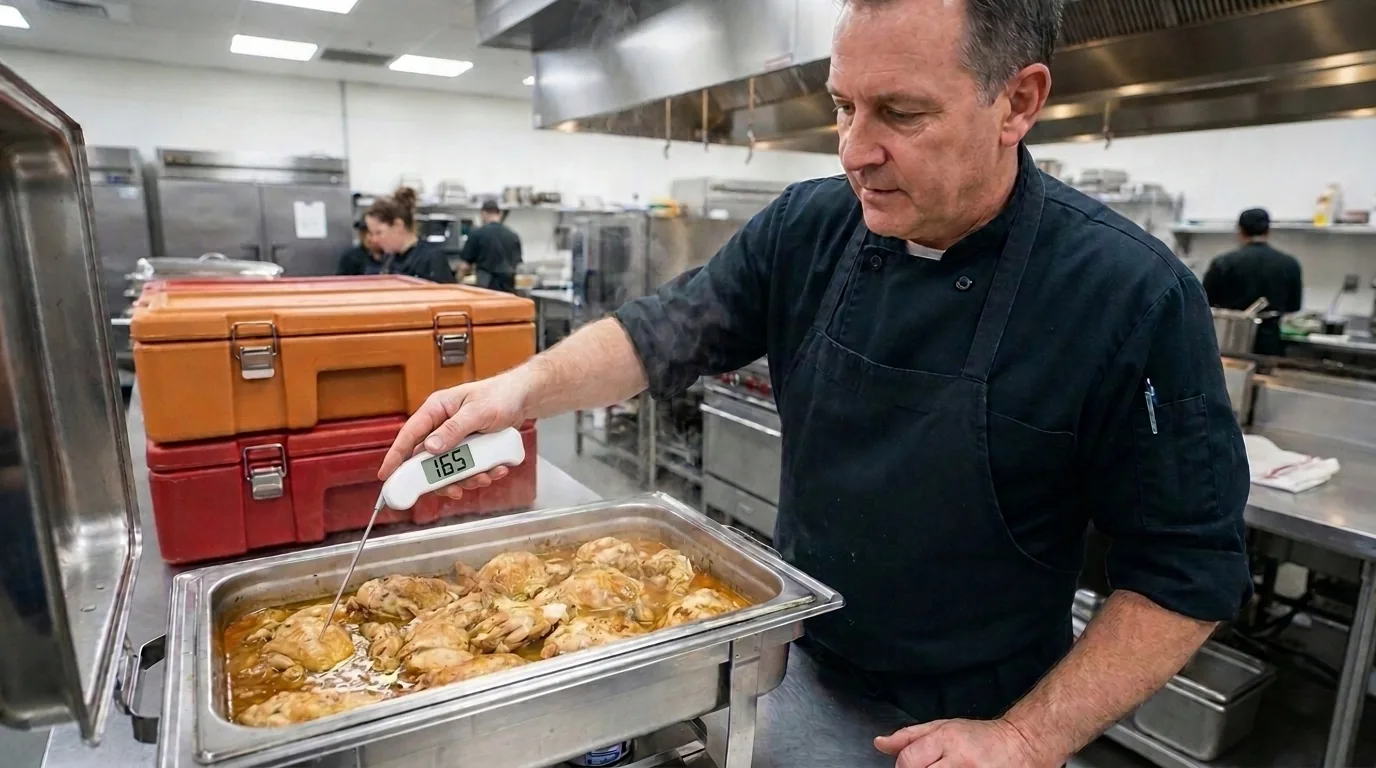
This is the question almost nobody asks and the one that most reliably separates operations. Food cooked in a licensed commercial kitchen and transported in insulated carriers behaves very differently from food cooked at 6 AM and held in a warm van for four hours.
Minnesota’s food code sets the temperature danger zone at 41°F to 135°F, and a catering business is responsible for controlling food safety from preparation all the way through service (see the MDH Catering fact sheet in Sources).
The USDA’s consumer guidance uses a slightly wider range of 40°F to 140°F, so the federal advice is a bit more cautious. A caterer who holds hot food at 140°F or above and cold food at 40°F or below meets both standards. One who can tell you which standard they follow, and how, thinks about this every day.
Good answerA named licensed kitchen, insulated transport, and a hot-hold method at the venue. Bonus if they mention temping food on arrival.
Red flagCooking out of an unlicensed or home kitchen, or no clear answer about how food stays above 135°F between the kitchen and your guests.
8. How Do You Handle Dietary Restrictions and Allergies?
Every caterer will say yes. The distinction is in the process. Cross-contamination is a kitchen-workflow problem, not a menu problem, and the answer should describe workflow.
Good answerSeparate prep surfaces and utensils, labeled plates, a deadline for collecting restrictions, and a plan to hand allergy meals directly to the right guest rather than leaving them on a buffet.
Red flag“We can just leave that ingredient off.” For a genuine allergy, omission without separation is not a safe answer.
If you are still shaping the menu itself rather than vetting the caterer, our guide on how to customize catering menus for any event walks through dietary planning and menu customization in more depth.
9. Is There a Tasting, Does It Cost Anything, and Can I Change the Menu Afterward?
Tasting policies vary widely and reasonably. Some caterers do them free for events above a certain size, some charge a fee that is credited back if you book, and some do not offer them for small drop-off orders at all. All of those are legitimate. What you need to know is which one applies and what happens after.
Good answerA clear policy on cost and timing, plus a stated window for menu changes after the tasting and any price implications.
Red flagA menu that is locked at signing with no adjustment window, or a tasting scheduled after the point where changes are still possible.
Questions 10–12: Licensing, Staffing, and the Day Itself
10. Are You Licensed and Insured, and Can I See the Documents?
In Minnesota, this is not a formality. All caterers operating in the state must comply with the Minnesota food code. Depending on the menu and location, the license comes from the Minnesota Department of Health, the Department of Agriculture, or a delegated local agency. The code also requires a Certified Food Protection Manager in most food establishments.
Alcohol follows separate rules. A caterer that sells alcohol at your event needs a Caterer’s Permit from the Department of Public Safety. If the venue serves under its own liquor license, or you supply the drinks at a private event and nothing is sold, different rules apply, so confirm the setup with your venue and city.
One detail worth knowing if your event has a bar: a Minnesota Caterer’s Permit is tied to an existing on-sale liquor license, and the permit stops being valid if that on-sale license lapses. A caterer cannot hold catering alcohol authority on its own. If someone tells you they will “handle the bar,” ask which on-sale license the permit sits under.
Good answerThey send the license and a certificate of liability insurance without hesitation, and many venues will require the certificate on file anyway.
Red flagDeflection, delay, or “we’ve never needed that.” Both documents should be a same-day email.
11. How Many Staff Will Be On-Site, and Who Is Running My Event?
Staffing ratios drive service pace more than anything else on the quote. A common industry guide is one server per 10–12 guests for plated dinner service, one per 20–30 for a staffed buffet, and no staff at all for drop-off. Beyond the ratio, you want a name: the person on-site making decisions, who may not be the person who sold you the booking.
Good answerA specific headcount, a named on-site lead, and their cell number in the week before the event.
Red flagNo named contact, or a salesperson who will not be there and has not designated a replacement.
12. What Happens to the Leftovers, and Who Handles Cleanup?
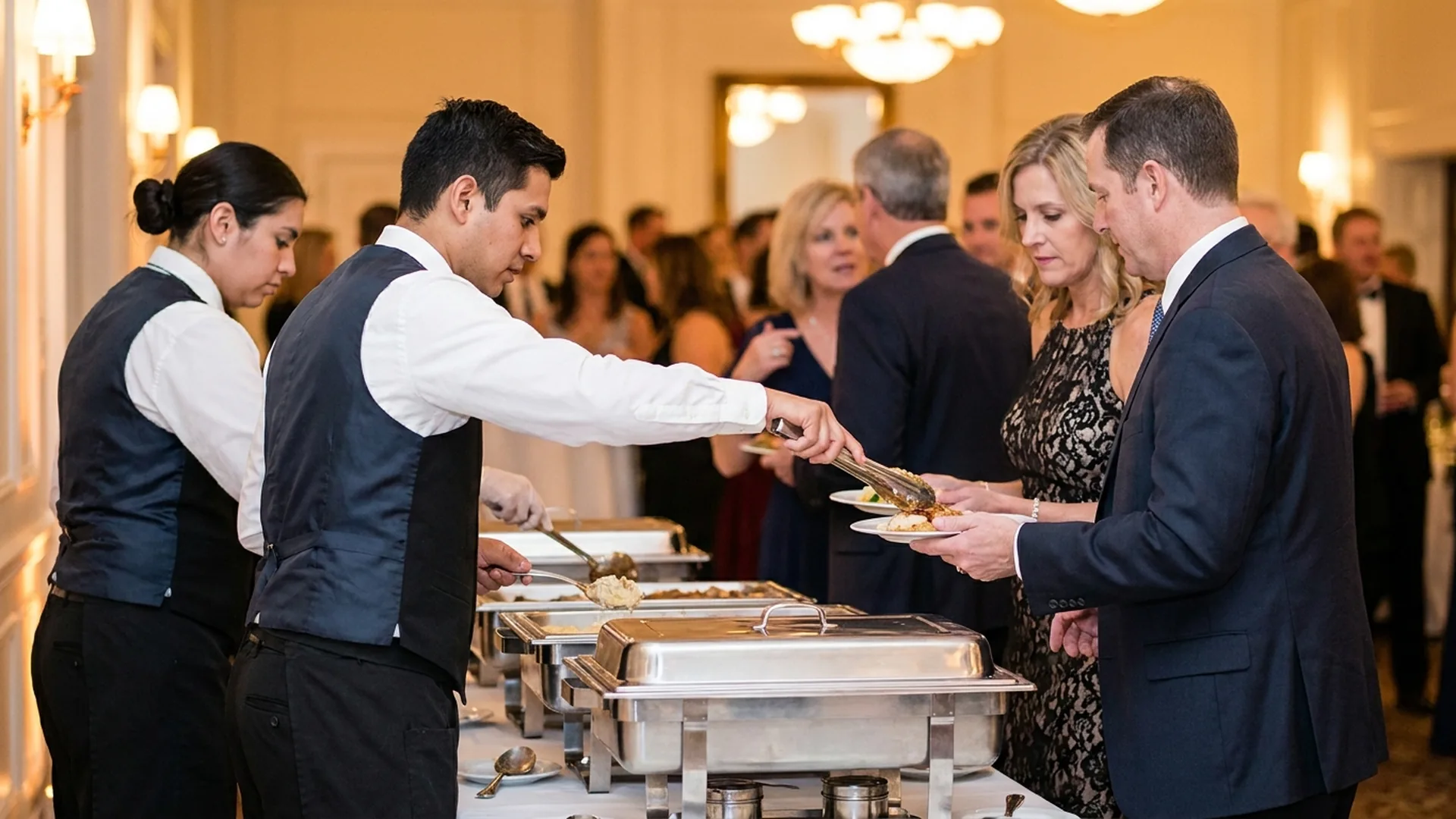
Two separate questions that both get skipped, and both cause friction at the end of the night when everyone is tired. Cleanup scope should be explicit: whether the caterer buses tables, bags trash, takes trash off-site, and what condition the kitchen gets left in. Leftovers have a food-safety dimension too, since a caterer who has held food properly can hand it off safely and one who has not should not.
Good answerA defined cleanup scope agreed up front, plus a clear leftover policy and containers if you are taking food home.
Red flag“We’ll see how it goes.” Cleanup responsibilities discovered at 11 PM become your problem.
If guests will be taking food home, our guide on keeping catered food safe covers the two-hour rule and safe leftover handling in detail.
Red Flags That Should End the Conversation
Individually, most of these warrant a direct follow-up question. Two or more together is usually your signal to keep looking.
What we actually see go wrong
In our experience, the events that fall apart are almost never the ones where the caterer turned out to be dishonest. They are the ones where something was assumed rather than confirmed, usually serviceware, staffing, or cleanup scope.
The host assumed plates were included, the caterer assumed the venue provided them, and nobody found out until the trays arrived. Every question above replaces an assumption with a clear answer.
How Far Ahead Should You Book?
Lead times vary more by event type than most hosts expect. Here is what we recommend for Central Minnesota events:
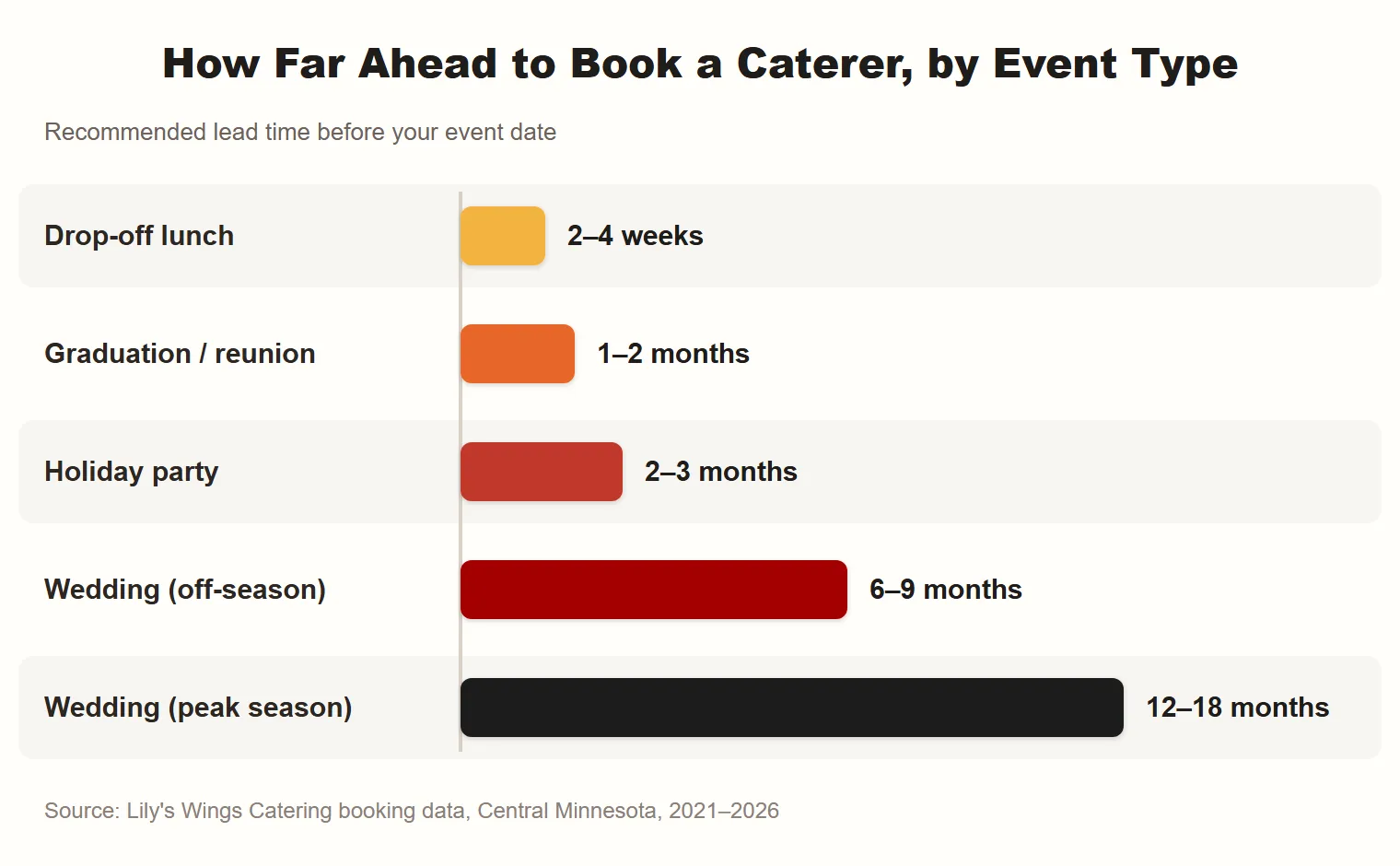
In Central Minnesota, the pressure points are Saturdays from May through October and the December holiday weekends. Those dates fill first and stay filled. If your event lands on one, move your timeline earlier than the ranges above rather than later. Planning a wedding? Our guide to how to organize catering for a wedding walks through the full planning process step by step.
Want Answers Like the Ones Above?
Lily’s Wings Catering serves weddings, corporate events, graduations, and reunions across Sartell, St. Cloud, Sauk Rapids, and the Twin Cities. Call or request a quote, and ask us all 12.
Lily’s Wings Burgers & Things · 1970 Sandstone Lp S, Sartell, MN 56377
Frequently Asked Questions
What Questions Should I Ask a Caterer Before Booking?
Start with fit: ask whether your date is open, how many other events they are booking that day, and whether they have worked your venue. Then ask about money: what the per-person price includes, the deposit and cancellation terms, and when the final headcount locks. Ask about the food: where it is cooked, how it arrives hot, how they handle allergies, and whether there is a tasting. Finally, ask to see their license and insurance, how many staff will be on-site, and who handles leftovers and cleanup. The answers matter more than the questions: vague pricing and no proof of licensing are the two biggest warning signs.
What Are Common Red Flags With Catering Companies?
The most common red flags start with a quote that has no itemized breakdown and no proof of a food license or liability insurance. Also watch for a booking deposit above 50% of the total and pressure to commit the same day. Vague answers about where food is cooked, or no named contact for the event day, are warning signs too. Missing license or insurance is a reason to walk away. Each of the others is worth a direct follow-up question, and two or more together usually means you should keep looking.
How Far in Advance Should You Book a Caterer?
Book 2–4 weeks ahead for a small corporate lunch or drop-off party, 1–2 months for a graduation or family reunion, 2–3 months for a holiday party, 6–9 months for an off-season wedding, and 12–18 months for a peak-season Saturday wedding. In Central Minnesota, May through October Saturdays and December holiday dates fill first, so book earlier than these ranges if your event falls on one.
Do Caterers Need a License in Minnesota?
Yes. All caterers operating in Minnesota must comply with the Minnesota food code. Depending on the menu and location, the license comes from the Minnesota Department of Health, the Department of Agriculture, or a delegated local agency. The Minnesota food code also requires a Certified Food Protection Manager in most food establishments. A caterer that sells alcohol also needs a separate Caterer’s Permit from the Minnesota Department of Public Safety, though a venue’s own liquor license or host-supplied drinks at a private event follow different rules. Ask any caterer to show you their current license.
Do Caterers Provide Plates, Utensils, and Linens?
It varies, which is exactly why you have to ask. Drop-off catering usually includes disposable serviceware or nothing at all, while full-service packages typically include china, flatware, glassware, and linens as either a bundled or add-on line item. Get it itemized in the quote. Assuming plates are included and discovering otherwise the week of your event is one of the most common and most avoidable catering surprises.
Sources
- Minnesota Department of Health, “Licensing Food, Pools, and Lodging Services,” retrieved 2026-10-06, health.state.mn.us/communities/environment/food/license
- Minnesota Department of Health, “Certified Food Protection Manager (CFPM),” retrieved 2026-10-06, health.state.mn.us/communities/environment/food/cfpm
- The Knot, “Do You Know The Average Wedding Catering Cost Couples Pay?” 2025 Real Weddings Study, retrieved 2026-10-06, theknot.com/content/average-cost-wedding-catering
- Minnesota Department of Health, “Catering: Food Safety During Preparation, Transport and Service,” January 2019, retrieved 2026-10-06, health.state.mn.us (PDF)
- USDA Food Safety and Inspection Service, “Danger Zone (40°F – 140°F),” retrieved 2026-10-06, fsis.usda.gov
- Minnesota Department of Public Safety, “Caterer’s Permit with Alcohol,” retrieved 2026-10-06, mn.gov/elicense
- Minnesota Statutes, section 340A.404, “Intoxicating Liquor; On-Sale Licenses,” subdivision 12 (Caterer’s permit), retrieved 2026-10-06, revisor.mn.gov/statutes/cite/340A.404