

Sports Banquet Catering Ideas for a Team Awards Night
A sports banquet is not a regular catered dinner with trophies at the end. It has three constraints no other event has at once: a room full of teenagers who eat considerably more than the adults sitting next to them, a budget pooled from team families and fundraisers, and an awards program that will run longer than anyone scheduled it for.
Get those three right and the night works. Miss one and you get the two failure modes every athletic director has seen: running out of food before the last table goes through the line, or serving a cold plate because the meal was held while a coach read 40 names.
Whether your school calls it a sports banquet, an athletic banquet, or a team awards night, the catering problems are the same. This guide covers portions for athletes, what a banquet costs per person, how to time the meal around the program, and how to work around a school cafeteria with no usable kitchen.
Quick Summary
| Key Point | Explanation |
|---|---|
| Count each athlete as 1.5 adults | That multiplier is our own rule of thumb, not a published standard, but the appetite behind it is real: adolescent males need about 2,000–3,200 calories a day and females 1,800–2,400 before training is added, per figures cited in a 2023 review of young-athlete nutrition. |
| Budget $12–$28 per person | Before tax and service charges. Drop-off buffets start near $12–$16; staffed service with cleanup runs $22–$28. |
| Serve the meal first, awards second | Holding food through a 45-minute program dries it out and gives it more time to slip below a safe holding temperature. |
| Your headcount is not your roster | Athletes, two parents each, siblings, coaches, and often an honored JV squad can turn a 22-player varsity team into 85–95 plates. |
What Makes a Sports Banquet Different from Other Catered Events
Three things, and they compound. The guest mix skews young and hungry, the budget is fixed before the menu is chosen, and the evening has a program attached that competes with the meal for time.
Most catering mistakes at team banquets trace back to treating the event like a corporate dinner with a slideshow. A corporate dinner has predictable adult portions, a flexible budget, and a 10-minute set of remarks. A sports banquet has none of those.
The Headcount Problem
Start here, because everything else scales off it. A varsity roster of 22 athletes is not a 22-person event. Add two parents per athlete, a sibling for maybe a third of them, the coaching staff, and often a JV squad being honored at the same time, and you are catering for 85 to 95 people.
Get the RSVP mechanism right early. Banquets that collect a per-athlete fee covering the athlete plus two guests give you a hard number weeks out. Banquets that send a sign-up sheet home in a gym bag give you a guess.
How Much Food Do Teenage Athletes Actually Eat?
More than you are planning for. Adolescent males generally need about 2,000 to 3,200 calories a day and adolescent females about 1,800 to 2,400, according to U.S. Dietary Guidelines figures cited in a review of young-athlete nutrition in the Journal of the Pediatric Orthopaedic Society of North America (Hecht et al., 2023).[1]
Those are baseline figures for all teens. The review adds that young athletes also burn energy in training, competition, and recovery, so a team coming off a season of daily practices will likely eat toward the top of that range, and a banquet is often the largest meal of their day.
Daily calorie needs are not the same thing as buffet portions, though. The ordering rule we recommend is a rule of thumb rather than a research figure: count each athlete as 1.5 adults.
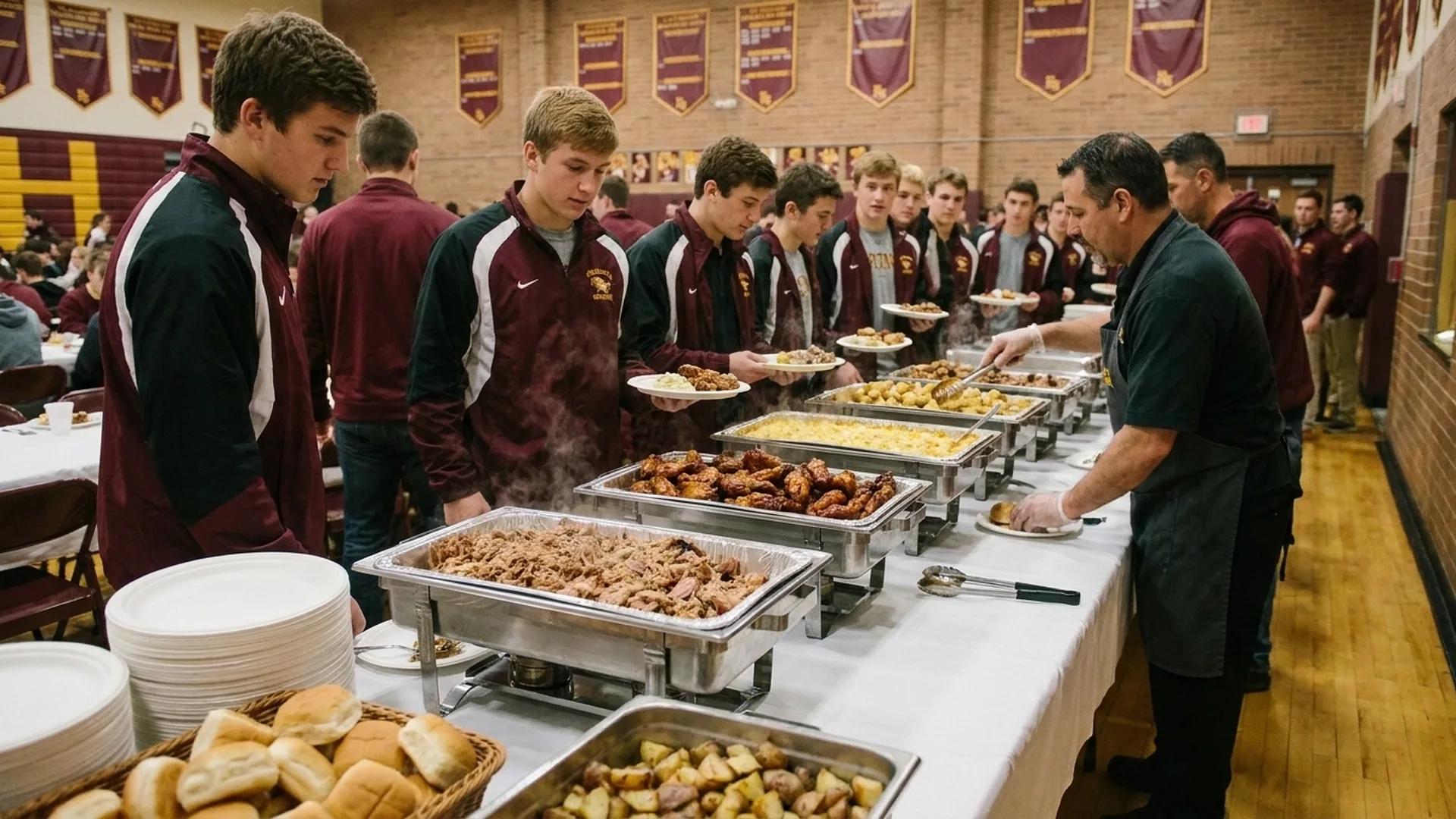
Athletes go through the line first, come back for seconds, and finish whatever is left on the serving trays. A 90-person banquet with 22 athletes gets ordered as though roughly 101 adults are attending.
Portion Planning: Athletes vs Adult Guests
| Item | Per Adult Guest | Per Teen Athlete |
|---|---|---|
| Main protein (chicken tenders) | 5–6 oz | 8–9 oz |
| Bone-in wings | 5–6 wings | 8–9 wings |
| Starch (mac and cheese, mashed potatoes) | 4–5 oz | 6–8 oz |
| Salad or coleslaw | 3–4 oz | 3–4 oz |
| Buns or rolls | 1–2 | 2–3 |
| Dessert | 1 serving | 1.5 servings |
| Beverages | 2 drinks | 3 drinks |
Where banquet orders run short
Salad and vegetables are the one line where athletes and adults eat about the same, so there is little reason to over-order them. The starch is where orders run short. Mac and cheese and mashed potatoes go fast with a teenage crowd, and an extra tray of either costs less than adding a second protein.
Sports Banquet Menu Ideas: What to Serve at an Awards Night
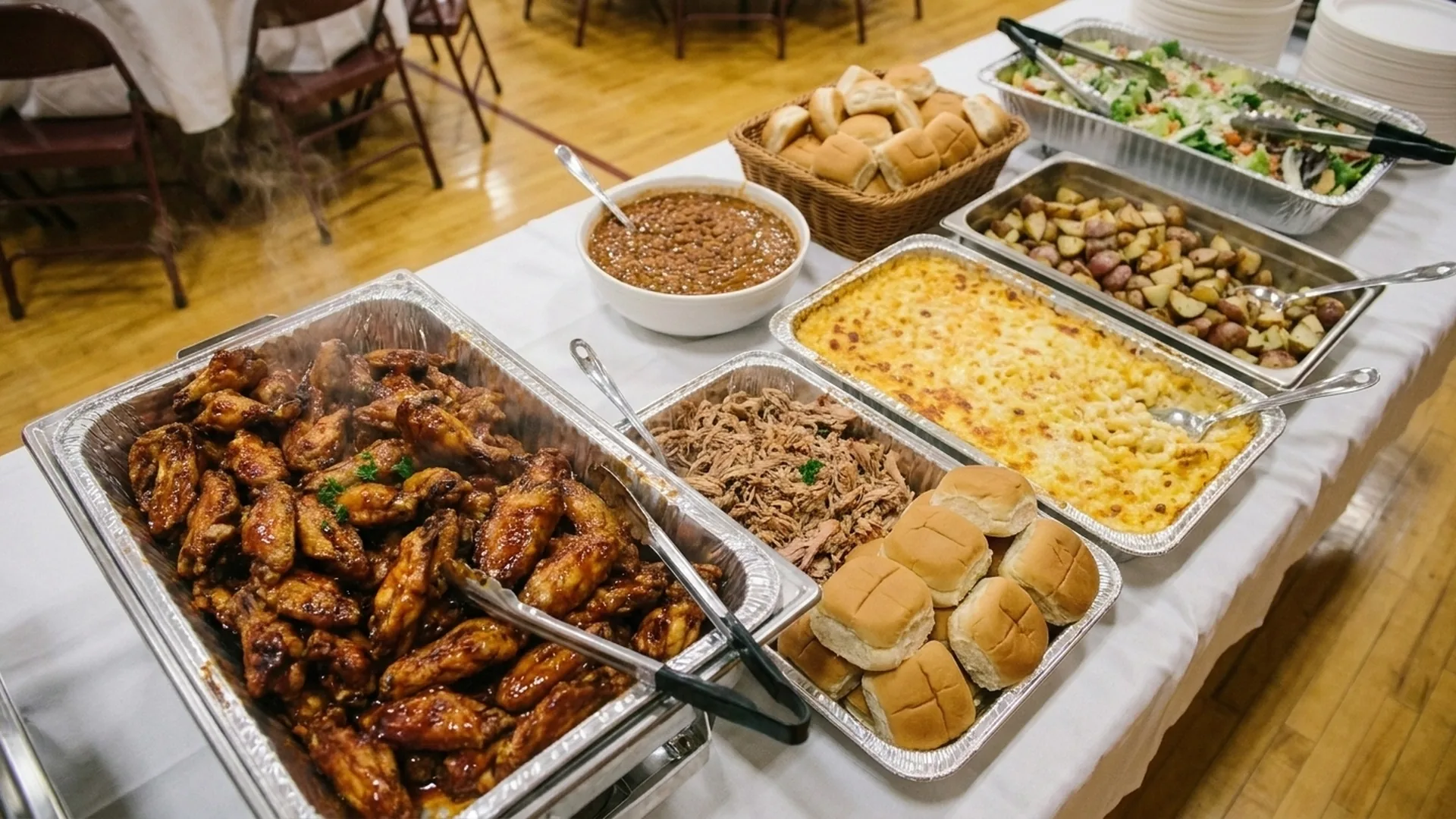
Buffet comfort food that holds heat and moves a line quickly. The menu constraints are specific: it has to survive a holding period, feed big appetites affordably, satisfy picky 15-year-olds and their grandparents in the same room, and get 90 people through the line in about 20–25 minutes.
That favors BBQ and handhelds over plated proteins. Two proteins usually work best: one completely familiar, one a little more exciting. The same approach works for a football banquet, a volleyball banquet, or an all-sports awards night.
| Course | What Works | Why It Fits a Banquet |
|---|---|---|
| Protein #1 (familiar) | Hand-breaded chicken tenders | Familiar to every guest and quick to eat |
| Protein #2 (the draw) | Wings (one mild sauce, one hot) or pulled pork | Reads as a treat to athletes; two sauces cover every spice tolerance |
| Starch | Mac and cheese | One of the first trays to empty with a teenage crowd |
| Starch #2 | Mashed potatoes or baked beans | Cheap per serving and holds well in a chafing dish |
| Cold side | Garden salad or coleslaw | Satisfies parents; one serving per head is plenty |
| Dessert | Sheet cake in team colors, often ordered from a bakery by the team | Doubles as the visual centerpiece for photos |
| Beverages | Water plus one or two other drinks | Confirm whether drinks come from the caterer or the team |
Serving Format Matters More Than the Menu
A double-sided buffet line serves roughly twice as fast as a single-sided one, which can keep the program from starting late. Figure about 20–25 minutes to get 90 guests through a double-sided line, and up to twice that for a single-sided one.
If the venue allows it, set the buffet as an island with identical food on both sides and start athletes from both ends. Our overview of how buffet catering works covers station layout and guest flow in more detail.
For help shaping a menu around specific dietary needs in the group, our guide on how to customize catering menus for any event covers allergy planning and substitutions in more depth.
Should You Serve Before or After the Awards Program?
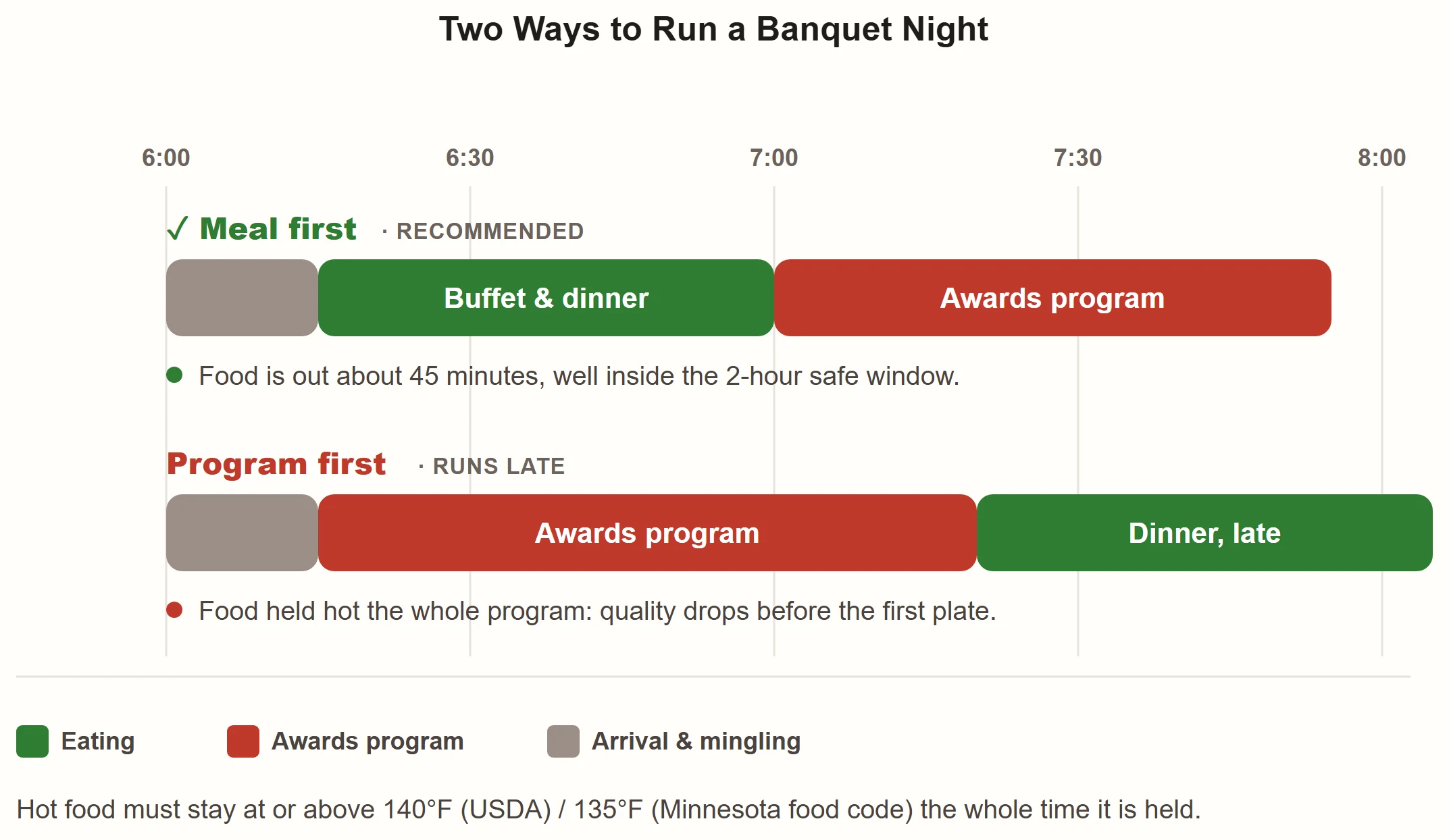
Serve first. Almost always. This is the most consequential scheduling decision of the night, and the instinct to “get the program out of the way” is the wrong one.
Two reasons. The first is food quality: a program scheduled for 30 minutes runs 45 to 60 once every senior gets a mention, and food held in open chafing dishes that whole time arrives dry.
The second is food safety. USDA guidance is to keep hot food at 140°F or above and to throw out perishable food left at room temperature for more than two hours.[2] Minnesota’s food code sets its limits at 135°F for hot holding and 41°F for cold holding.[3]
Food held at those temperatures stays safe, but every extra minute of program is another chance for a pan to slip below them. That is why hot pans should be checked with a probe thermometer throughout service. Our guide on keeping catered food safe breaks down the two-hour rule and hot-holding in more detail.
If the Program Has to Come First
Sometimes the venue or a guest speaker forces it. In that case, keep the program to 20 minutes hard, have the caterer hold food in insulated carriers instead of open chafing dishes, and put out a light appetizer so a room of hungry athletes is not listening to speeches on an empty stomach.
Tell your caterer the plan in advance so they time their arrival to it rather than to the invitation time.
Tell the caterer the real program length
Organizers routinely quote the printed schedule, not what actually happens. If your awards night has run 55 minutes for three years running, tell the caterer 55 minutes, not the 30 on the agenda. It changes how they hold food, how much sterno they bring, and when they arrive, so put the real number in front of your caterer before you sign the contract.
Sports Banquet Catering Cost per Person
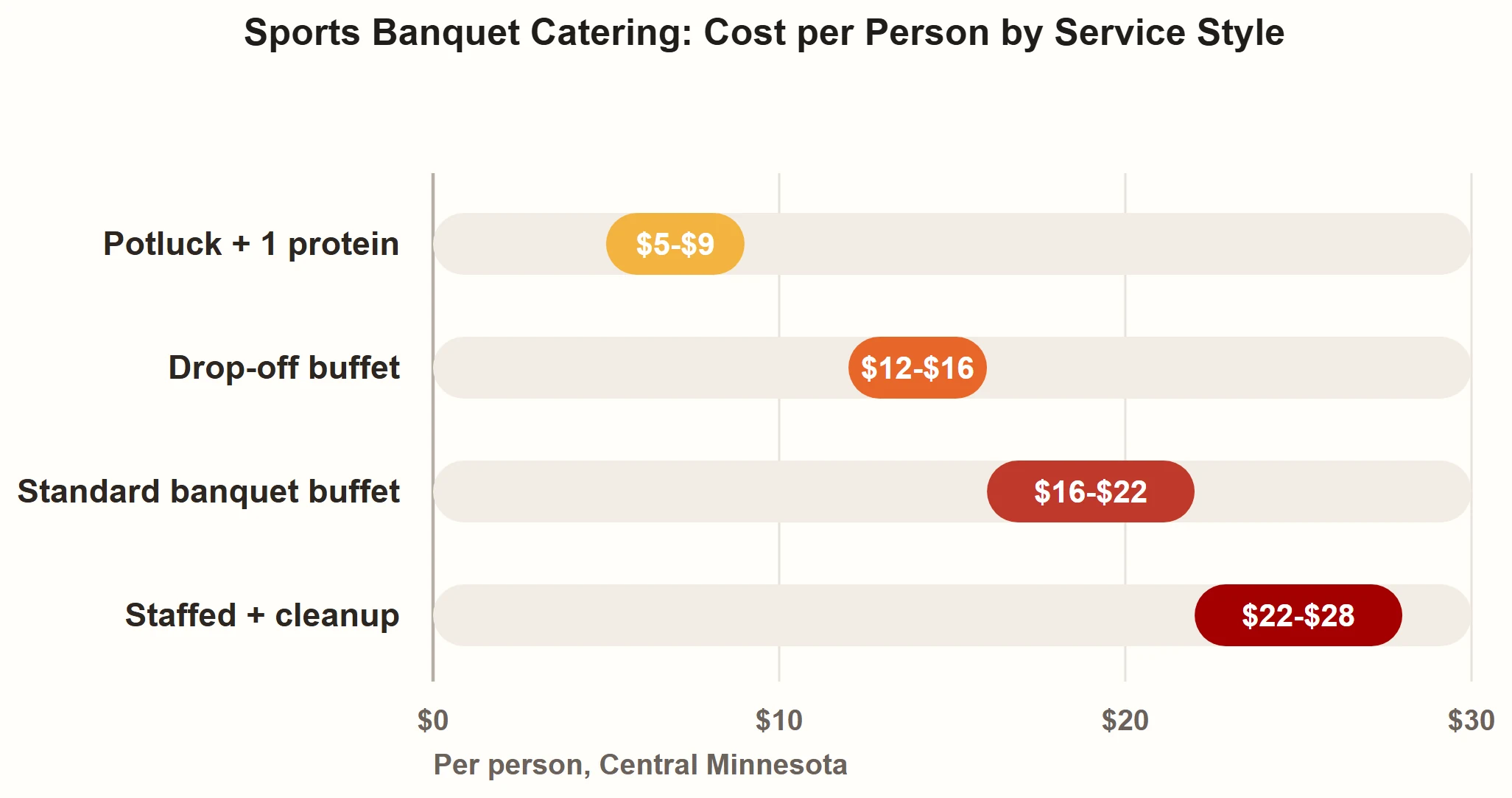
Sports banquet catering runs about $12–$28 per person in Central Minnesota before tax and service charges, depending mostly on how much of the work the caterer handles.
Lily’s Wings Catering packages through our St. Cloud event catering service run $15 to $25 per person for food, and every tier includes setup and teardown. Food-truck rental and travel fees may apply.
Across the market, a basic drop-off buffet with one protein, two sides, and rolls starts at $12–$16 per head. A standard banquet spread with two proteins, three sides, and dessert lands at $16–$22. Staffed service with setup, serving, and cleanup runs $22–$28.
Teams on the tightest budgets sometimes run a potluck and cater only the main protein, which we estimate at roughly $5–$9 per head.
For a 90-person banquet that is roughly $1,100 at the low end and $2,500 at the high end. The standard two-protein spread in the middle works out to about $1,450 to $2,000.
How Teams Usually Fund It
- Per-athlete fee: for example, $20–$40 covering the athlete plus two guests. Gives you a hard headcount weeks out.
- Ticket sales at the door: flexible but leaves you ordering blind. Avoid if possible.
- Fundraiser-funded: banquet paid from the season’s concession or raffle proceeds; athletes attend free.
- Hybrid: athletes eat free and adult guests pay, for example $10–$15 each. Keeps cost off families with multiple kids in sports.
The cheapest real lever is service style, not menu
Dropping staffed service saves about $6 per head on the same menu, and trimming to a basic drop-off menu saves about $10–$12. Either move usually saves more than swapping proteins. The trade-off is that parent volunteers end up working the line instead of watching their kid get an award.
Working Around a School Cafeteria or Gym
Most banquets happen in a school cafeteria, a gym, or a community center, and all three come with constraints that a caterer needs to know about before quoting.
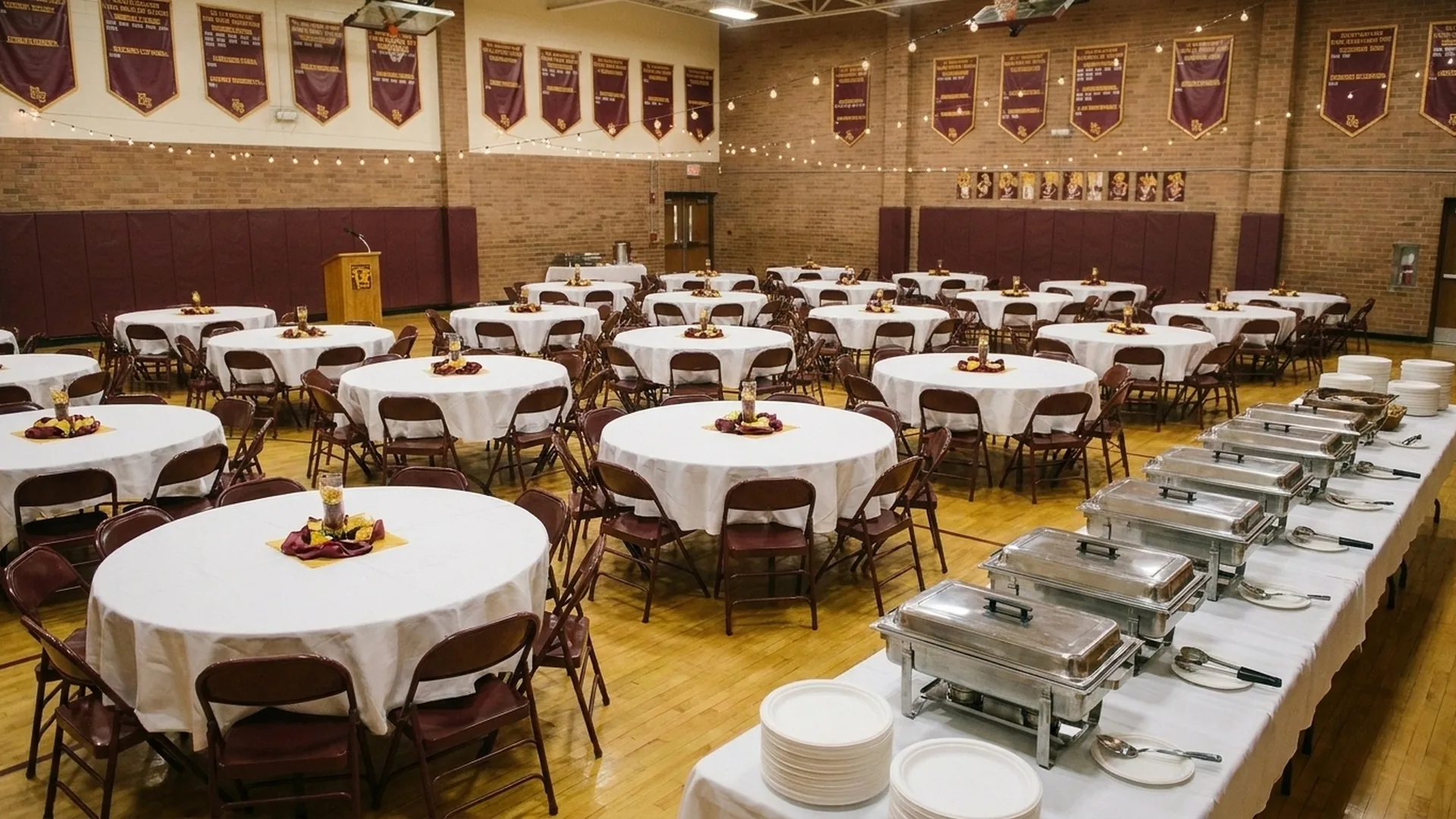
| Constraint | What to Check | Why It Matters |
|---|---|---|
| Kitchen access | Is the school kitchen available to outside caterers? | If not, the caterer must arrive fully cooked and hot |
| Outlets | How many, and where relative to the buffet? | Determines sterno vs electric warming |
| Load-in | Door closest to the room, and is it unlocked? | A long carry cools food and slows setup |
| Tables | Does the school provide them, or are they rented? | Buffet needs 2–3 eight-foot tables minimum |
| Custodial | Who is on duty, and until when? | Hard end times are real; overtime gets billed back |
| Trash | Does the caterer pack out or use school dumpsters? | Common source of end-of-night friction |
| Sound | Is there a working mic and speaker? | A 90-person room needs amplification for awards |
The kitchen-access question is the one that most often surprises people. Some districts will not open a licensed school kitchen to an outside vendor, and when that happens the caterer must deliver food fully cooked and held hot. That is routine for an experienced caterer but changes the menu: anything requiring a final oven finish comes off the list.
When to Book Catering for a Fall Sports Banquet
Book as soon as you have a date, but a banquet a week or two away isn’t too late. Lily’s Wings asks for 1–2 weeks’ notice and can handle many events on as little as 3 days’ notice.
Football, volleyball, soccer, and cross country banquets cluster in late October through November, as Minnesota’s fall seasons wrap up, and deep football playoff runs can push some into early December. Neighboring schools often pick the same few weeknights, so calling early gives you the widest choice of dates.
Spring sports banquets follow the same pattern in late May and June, after section and state tournaments wrap up, so if you organize for a program with both seasons, book both at once and ask whether your caterer will put both dates on one contract.
Sports Banquet Catering in St. Cloud and Central Minnesota
Lily’s Wings Catering brings BBQ catering to sporting events and award ceremonies across Sartell, St. Cloud, Sauk Rapids, and the rest of Central Minnesota. Wings, hand-breaded tenders, pulled pork, and mac and cheese. Tell us your athlete count and we will size the order around it. Food packages from $15 per person, with setup and teardown included.
Lily’s Wings Burgers & Things · 1970 Sandstone Lp S, Sartell, MN 56377
Frequently Asked Questions
How Much Does It Cost to Cater a Sports Banquet?
Budget $12 to $28 per person in Central Minnesota before tax and service charges, depending on how much of the work the caterer handles. A drop-off buffet with one protein, a couple of sides, and rolls sits at the $12–$16 end. A fuller spread with two proteins, three sides, and dessert runs $16–$22.
Add staff to set up, serve, and clean up and you land at $22–$28. For 90 guests, plan on roughly $1,100 to $2,500 for the food.
How Much Food Do You Need per Person at a Sports Banquet?
More than a room of adults would eat. Published figures put teenage boys around 2,000–3,200 calories a day and teenage girls at 1,800–2,400, with needs rising alongside training load.
A good ordering rule of thumb is to count each athlete as 1.5 adults: about 8–9 ounces of protein each against 5–6 for adults, plus an extra helping of starch. For 80 guests with 20 athletes, order as if 90 adults are coming. When in doubt, round up, because running short is harder to fix than leftovers.
Do Parents Come to Sports Banquets?
Usually, yes. Team banquets commonly invite parents, and many invite siblings too, so plan the food around the full guest list rather than the roster. A 22-player varsity team with two parents per athlete, some siblings, the coaches, and an honored JV squad can reach 85 to 95 guests.
Should You Serve Food Before or After the Awards Program?
Feed everyone first, then hand out the awards. A ceremony booked for 30 minutes tends to stretch to 45 or 60, and anything left in open chafing dishes that long dries out and has more time to slip below a safe holding temperature.
Serving first also settles a hungry room before the speeches begin. If the program truly has to lead, cap it at 20 minutes and have the caterer hold everything in insulated carriers instead of open pans.
What Food Should You Serve at a Team Awards Banquet?
Stick to crowd-pleasing buffet food that holds its heat: chicken tenders, wings or pulled pork, mac and cheese, baked beans or mashed potatoes, and a garden salad or coleslaw.
Pair one safe protein with one that reads as a treat so the picky and the adventurous eaters are both happy. Handhelds like wings, tenders, and pulled pork sandwiches clear a line quicker than plated mains, which counts when 90 people have to eat before a program starts.
Sources
- Hecht C, Bank N, Cook B, Mistovich RJ. “Nutritional Recommendations for the Young Athlete.” Journal of the Pediatric Orthopaedic Society of North America, 2023 Feb;5(1):599. doi:10.55275/JPOSNA-2023-599. PMID: 40433081. Retrieved 2026-10-06, pmc.ncbi.nlm.nih.gov
- USDA Food Safety and Inspection Service, “Danger Zone (40°F – 140°F),” retrieved 2026-10-06, fsis.usda.gov
- Minnesota Department of Health, “Temperature and Time Requirements for Food: Controlling Growth of Foodborne Pathogens,” January 2019, retrieved 2026-10-06, health.state.mn.us (PDF)