
Nobody skips the company picnic because the cornhole boards were the wrong color. They skip because the invite read like a summons and the food looked like an afterthought.
Turnout is the whole game. A picnic half the team ducks out of costs far more than the catering bill, because it quietly confirms what your least-engaged employees already suspect about how much the company values them.
In 2025, global employee engagement fell to 20%, the lowest level since 2020, costing the world economy roughly $10 trillion in lost productivity, or 9% of global GDP (Gallup, State of the Global Workplace 2026).
A well-run company picnic will not fix disengagement on its own, but a poorly-run one reinforces it. Done well, it signals the company values people beyond their output.
This guide is for the person actually planning the picnic. It covers what to serve, what to spend, what games get played instead of stared at, and how to make sure people show up, based on 2025-2026 data and a decade of catering Central Minnesota corporate events.
Key Takeaways
- Team building delivers $4 return for every $1 invested when properly tracked (Group Dynamix, 2025), so this event has real ROI, not just optics.
- Budget $30-$60 per person all-in for a mid-sized picnic (food + venue + activities). Catering alone runs $12-$50 per head.
- Employees skip picnics when there is no clear plan, no shade, no plus-ones, or when the food is a bag of chips and hot dogs.
- Book food, venue, and activities 6-8 weeks out for peak summer weekends. Send calendar invites 4 weeks ahead with an actual agenda.
Why Do Most Company Picnics Fail to Land?
Most company picnics fail because they are planned as an obligation, not an experience. Only 20% of employees feel engaged at work (Gallup, State of the Global Workplace 2026), and a lackluster picnic reinforces that disengagement rather than repairing it. If the invite reads like a homework assignment, the RSVP rate will match.
The three failure modes we see over and over as caterers to corporate clients:
2. Food that reads as “we didn’t try.” A pile of grocery-store buns and lukewarm hot dogs sends a clear message about how much the company values the event.
3. Wrong timing. Sunday afternoons, 8 a.m. Saturdays, and any date the week before school starts have terrible turnout.
Original observation
Across the corporate picnics we cater in Central Minnesota, the events with the highest satisfaction have three things in common: a printed 3-line agenda (“food 12-1, games 1-2:30, awards + cake 2:30-3”), one specific team activity everyone can join, and a dessert that is not a Costco sheet cake. Nothing fancy. Just intentional.
What Should a Summer Company Picnic Budget Look Like?
Budget $30-$60 per person all-in for a well-run summer picnic in 2026, which covers catering, venue, activities, and a small amenities buffer. Nationally, company picnic catering alone runs $12-$50 per person depending on menu tier and service style (Bites by Braxtons, 2026 catering guide).
For a 50-person team, that puts your total picnic budget at $1,500-$3,000. Adding rentals (chairs, tents, tables), a bounce house, or a live band pushes that toward $4,500-$5,500. Below is the breakdown that fits most companies.
Where the Budget Actually Goes
- Food and drinks: 50-60% of total budget
- Venue rental: 15-25% (skip this by using a park pavilion)
- Rentals (tents, tables, chairs): 10-15%
- Activities and prizes: 5-10%
- Miscellaneous (paper goods, decor, ice): 5%
When Is the Best Time to Host a Summer Company Picnic?
The best time to host a summer company picnic is late June or early August on a Thursday or Friday afternoon, from 12 p.m. to 3 p.m. Employees dislike weekend picnics because they eat into family time, and July is often crowded with vacations and holidays.
In 2019, BetterUp research found that high workplace belonging predicts a 56% increase in job performance and a 75% reduction in sick days (Harvard Business Review, “The Value of Belonging at Work”), so protecting attendance is not just about optics.
Weekday afternoons work because they count as paid time, which changes the entire mood. When the picnic is on the clock, employees show up as themselves, not as reluctant weekend attendees. The cost of 3 paid hours is far less than a picnic where only 40% of the team shows.

Dates to Avoid
- Any Sunday (family day, low RSVPs)
- The week of July 4th (half the office is at a lake)
- The last two weeks of August (back-to-school prep in Central Minnesota)
- The Friday of a long weekend (people leave town)
What Food Should You Serve at a Summer Company Picnic?
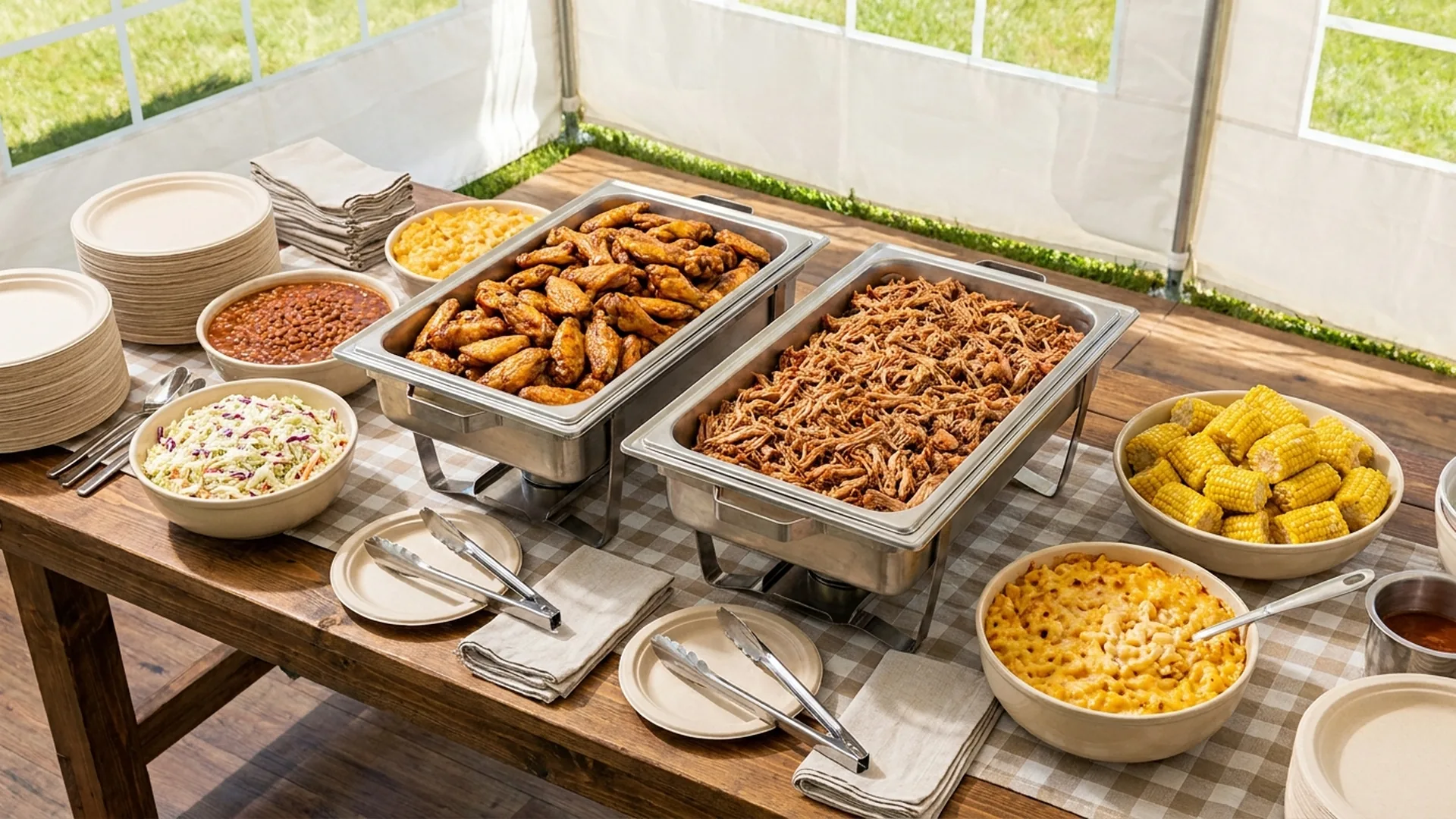
Serve 2 proteins, 3-4 sides, one vegetarian entrée, and a dessert. Skip the cook-your-own hot dog line and go with drop-off BBQ catering, which nationally runs $12-$50 per person for a full menu (Bites by Braxtons, 2026).
The single biggest attendance driver at a company picnic is the food. Get it right and people come back next year.
What actually gets eaten at every picnic we cater:
| Category | Crowd-Pleasers | Skip These |
|---|---|---|
| Proteins | Wings, pulled pork, grilled chicken | Full brisket (slow to eat), fish (smell) |
| Sides | Baked beans, coleslaw, corn on the cob, mac and cheese | Anything mayo-based sitting in the sun 3+ hours |
| Veg entrée | Grilled portobello, black bean burger, veggie tacos | A single sad salad “for the vegetarians” |
| Dessert | Ice cream cart, cookie tray, fruit bar | Sheet cake nobody cuts |
| Drinks | Lemonade, iced tea, bottled water, one beer option | Warm soda in a bucket |
Dietary Restrictions Without a Separate Menu
Roughly 90% of dietary needs at a corporate picnic get covered by adding one vegetarian entrée and clearly labeling every dish (gluten-free, dairy-free, contains nuts). Skip building a second full menu. What matters is that employees with restrictions can walk the buffet and know at a glance what they can eat.
Which Games and Activities Actually Get Employees Involved?
Low-pressure lawn games get the highest participation because they let coworkers chat and play at the same time. Cornhole, giant Jenga, bocce ball, and a scavenger hunt outperform any structured team-building exercise at a picnic.
Team-building programs deliver a 25% increase in team performance when they are well-designed (Group Dynamix, ROI of Team Building 2025), but a summer picnic is not the venue for a workshop.
The mistake most planners make is over-programming. Employees came for a break, not a mandatory ropes course. Give them 2-3 optional activity stations and let people opt in.
Personal experience
A St. Cloud company we catered for in 2025 tried a full-day “corporate olympics” the year before with mixed teams competing for prizes. It bombed. In 2025 they cut it down to 90 minutes of cornhole plus a raffle with real gift cards. Attendance jumped from 55% to 91%. The lesson: employees want to socialize, not compete.
Activities Worth the Money
- Under $200: Cornhole, giant Jenga, bocce ball (buy or rent)
- $200-$500: Face painter for family events, DJ playlist rental, branded photo backdrop
- $500-$1,500: Bounce house (family picnics only), inflatable obstacle course, live acoustic performer
- $1,500+: Full DJ, band, or interactive entertainment (skip unless the team is 100+)
Where Should You Host Your Company Picnic?
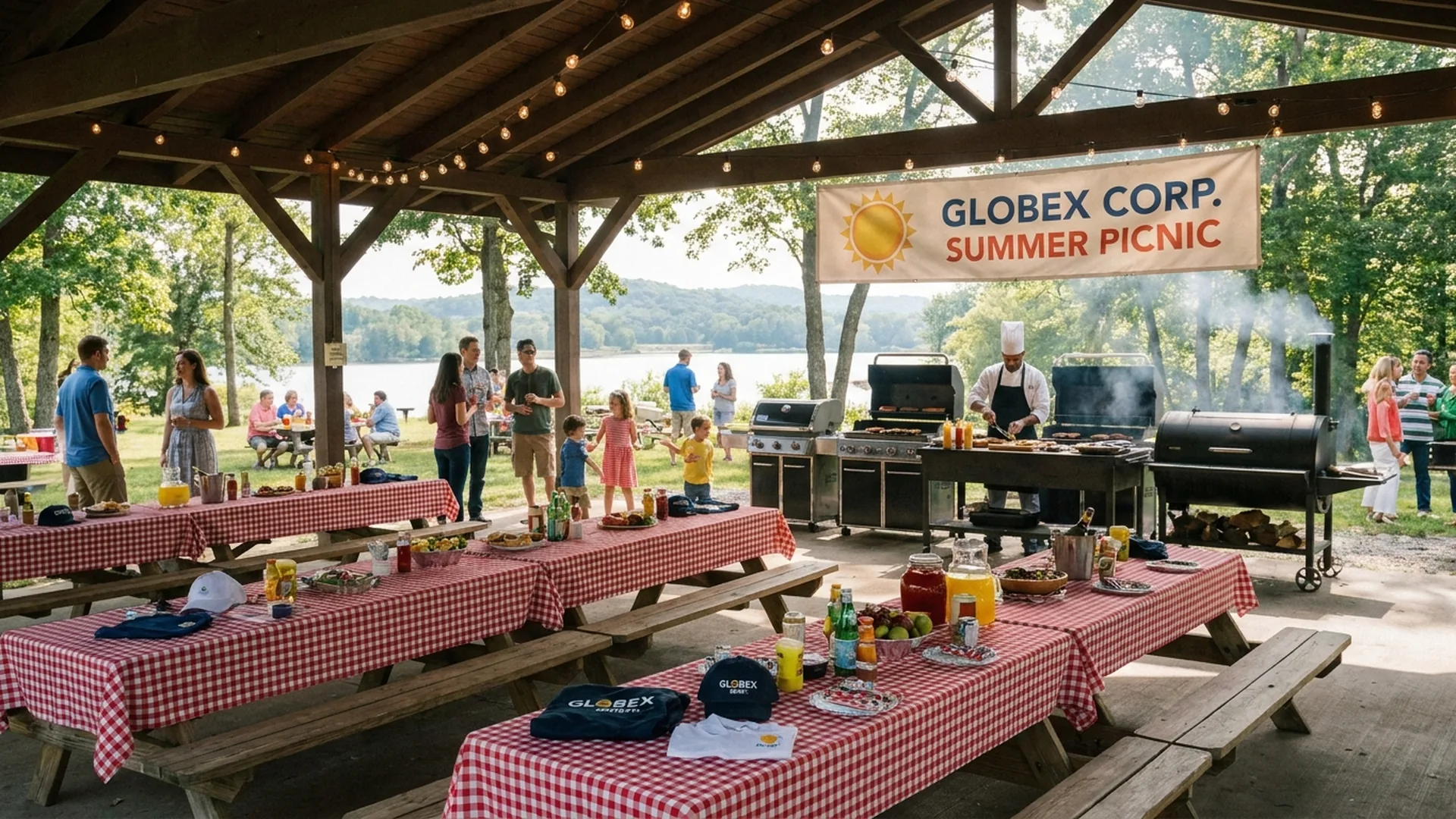
Local parks with covered pavilions are the best venue for most corporate picnics because they cost $0-$150 to reserve, have restrooms, and remove the setup burden.
Central Minnesota has excellent options like Riverside Park in St. Cloud, Sartell’s Watab Park, and Sauk Rapids’ Municipal Park. Book at least 6-8 weeks out for summer weekends.
For teams over 100 people or events with alcohol service, private venues make more sense. Expect $500-$2,000 for a venue with tables, bar area, and a rain contingency plan.
Venue Non-Negotiables
- Shade or covered pavilion (rain plan built in)
- Real restrooms (not just Porta-Potties)
- Accessible parking within 5 minutes of the event area
- Power access if you need speakers, warmers, or blenders
- Water source for cleanup and refills
How Do You Handle RSVPs, Plus-Ones, and Kids?
Send the invite 4 weeks out, require RSVPs 10 days ahead, and clearly say whether plus-ones and kids are included. Ambiguity kills attendance and blows your headcount. Well-designed team programs can raise employee retention by 36% (Group Dynamix, 2025), but only when the logistics feel welcoming, not confusing.
The RSVP language that gets responses:
Kids: Yes or No?
If you invite kids, plan for them separately. Add a face painter, a kid-friendly food option (mac and cheese, plain wings, fruit), and a designated kids area.
Kids at a picnic without any accommodations means stressed parents and less mingling among adults. If your team is small or mostly early-career, an adults-only picnic is completely fine, just be explicit about it.
Catering a Summer Company Picnic in Central Minnesota?
Lily’s Wings BBQ caters corporate picnics across St. Cloud, Sartell, Sauk Rapids, and surrounding areas. Wings, pulled pork, classic sides, and drop-off service starting at $15 per person.
Lily’s Wings Burgers & Things · 1970 Sandstone Lp S, Sartell, MN 56377
Frequently Asked Questions
What Should You Serve at a Summer Company Picnic?
Serve 2 proteins (wings and pulled pork work well), 3-4 sides (baked beans, coleslaw, corn, mac and cheese), one vegetarian entrée, and one dessert. Add bottled water, lemonade, and iced tea. National catering costs run $12-$50 per person for a full menu (Bites by Braxtons, 2026).
How Much Does a Company Picnic Cost per Person in 2026?
Budget $30-$60 per person all-in for a well-planned summer company picnic. Catering alone runs $12-$50 per person (Bites by Braxtons, 2026). For a 50-person team, expect a total budget of $1,500-$3,000 for a standard picnic. Premium picnics with bands, bounce houses, and bar service climb to $60-$110 per head.
How Do You Make a Company Picnic Fun for Employees?
Skip mandatory team-building exercises and go with low-pressure lawn games like cornhole, giant Jenga, and bocce ball. Add one photo moment (branded backdrop or polaroid station) and one small giveaway. Team-building activities deliver $4 return for every $1 invested when tracked correctly (Group Dynamix, 2025), but only when they feel voluntary.
How Far in Advance Should You Plan a Company Picnic?
Start 8-10 weeks out. Book the venue and caterer 6-8 weeks ahead for peak summer weekends. Send calendar invites 4 weeks in advance, and require RSVPs 10 days before the event. Peak summer weekends (June through August) fill fast at good venues and caterers in Central Minnesota.
Should Company Picnics Include Employees’ Families?
It depends on your team. Family-inclusive picnics boost attendance among employees with kids (often reaching 85%+ RSVPs) but require extra planning: kid-friendly food, a separate activity area, and a face painter or bounce house. Adults-only picnics are simpler and often work better for teams under 30 or with mostly early-career employees.