
Picture the potato salad. It is 2 p.m., pushing 88 degrees, and that big bowl has sat in the sun since guests arrived at noon. It still looks perfectly fine. That is exactly what makes it dangerous.
In 2024, the CDC reviewed 203 possible multistate foodborne outbreaks and investigated 62 of them, which together caused 2,605 illnesses and 861 hospitalizations (CDC, Summary of Possible Multistate Enteric Outbreaks 2024). Many of those started at parties and picnics where the food was left out too long. Nobody wants their summer barbecue on that list.
This guide covers the exact temperatures, timing, and setup steps that keep catered food safe at an outdoor party, based on USDA and FDA rules plus a decade of catering Central Minnesota summer events. Written for hosts, not health inspectors.
Key Takeaways
- The USDA “2-hour rule” says perishable food is unsafe after 2 hours out, or just 1 hour above 90°F (USDA FSIS).
- The “Danger Zone” is 40°F to 140°F. Keep hot food above 140°F and cold food below 40°F.
- Salmonella was the leading cause of solved multistate foodborne outbreaks in 2024 (CDC, 2024), and most of its risk comes from chicken, eggs, and unwashed produce.
- Set your buffet up in the shade, use chafing dishes and ice bowls, and swap platters every 60-90 minutes on hot days.
What Is the “Danger Zone” and Why Does It Matter at Summer Parties?
The Danger Zone is the temperature range between 40°F and 140°F, and it matters because bacteria that cause foodborne illness multiply fastest inside it (USDA Food Safety and Inspection Service). At an outdoor summer party in July, that middle zone is exactly where your buffet is sitting the whole time unless you actively keep it out.
The CDC estimates that major foodborne pathogens cause 5.9 to 15.4 million illnesses in the US each year, with 36,000 to 75,000 hospitalizations and up to 1,460 deaths annually (CDC, Burden of Foodborne Illness in the US). Summer barbecues and picnics contribute more than their fair share because outdoor temperatures compress the safe window.
Danger Zone facts every host should memorize
Bacteria can double in number in as little as 20 minutes inside 40°F-140°F. A pulled pork tray sitting at 85°F on a picnic table for 3 hours has grown roughly 500x the bacteria it started with. That is why 90°F+ days cut the safe window in half.
How Long Can Catered Food Actually Sit Out in Summer?
Perishable catered food is safe out for a maximum of 2 hours at temperatures under 90°F, and just 1 hour above 90°F (FDA, Handling Food Safely While Eating Outdoors). This applies whether the food is hot or cold. The clock starts when the food leaves the caterer’s insulated container or your refrigerator, not when guests start eating.
Most Central Minnesota summer parties hit 80°F-90°F between noon and 4 p.m. If your party runs that window, plan on the tight 1-hour rule for anything sitting in direct sun and 2 hours for anything staying in the shade.
Our observation from a decade of Central MN catering
The single most common food-safety mistake we see hosts make is refilling a hot chafing dish from a room-temperature backup platter instead of a fresh insulated container. That backup platter has been sitting out the whole party too. The first tray was safe. The refilled tray started the clock the moment the caterer left.
Hot Foods Must Stay Above 140°F
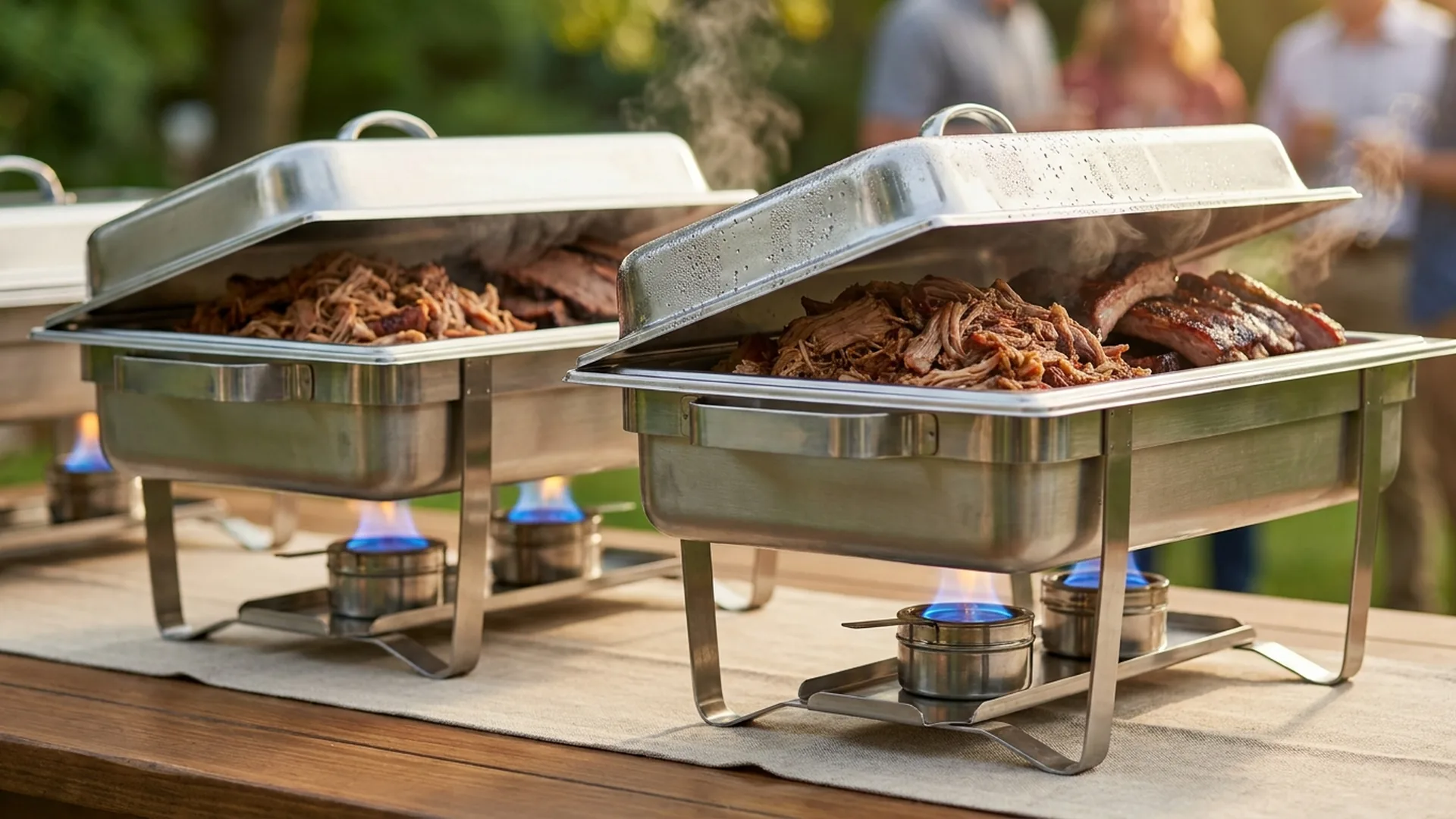
Hot catered foods must stay at 140°F or above the entire time they are out (USDA FSIS, Keep Clear of the Danger Zone). The tools that actually hold that temperature at an outdoor buffet: chafing dishes with sterno underneath, slow cookers on a “warm” setting, or insulated food carriers designed for hot hold.
Foods that get temperature-abused most often at outdoor parties:
| Hot Food | Target Temp | Best Hold Method |
|---|---|---|
| Wings, chicken | 140°F+ | Chafing dish with sterno |
| Pulled pork, brisket | 140°F+ | Chafing dish or slow cooker on “warm” |
| Baked beans | 140°F+ | Slow cooker or chafing dish |
| Mac and cheese | 140°F+ | Chafing dish (thickest surface area to heat) |
| Cornbread, rolls | Room temp OK | Covered basket, out of sun |
What NOT to Use for Hot Hold
Skip aluminum foil trays without a heat source, oven-warmed platters that leave the kitchen without insulation, and anything that relies on the food being “still warm from cooking.” Once a hot dish drops below 140°F, the Danger Zone clock has already started even if the food still feels warm to touch.
Cold Foods Must Stay Below 40°F
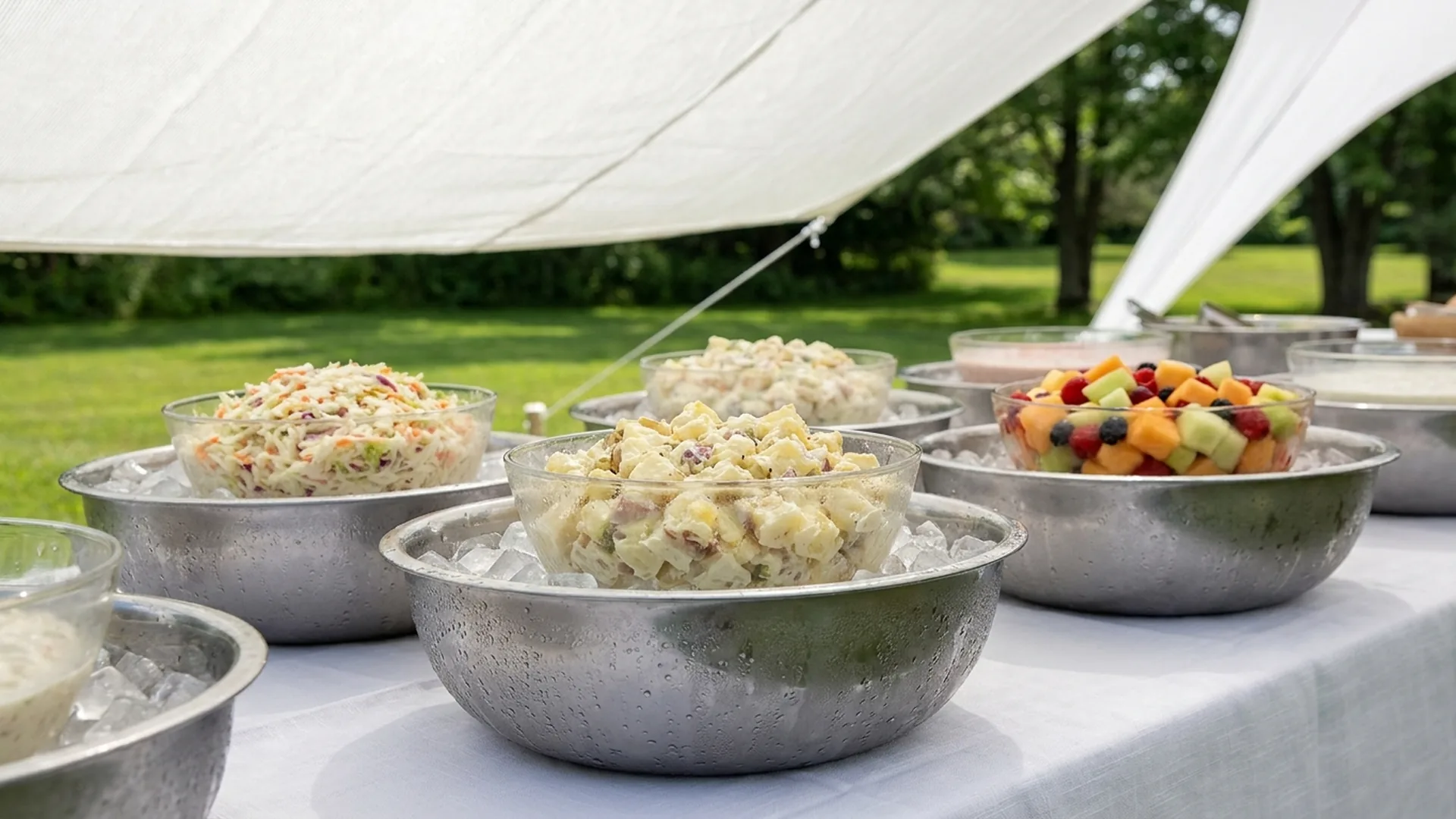
Cold catered foods must stay at 40°F or below the entire time they are out. The best outdoor tools: nested serving bowls sitting on top of larger bowls filled with ice, insulated coolers with drainage, or refrigerated portable units for bigger events. Direct sun destroys any of these fast, so shade is not optional.
Cold foods that get temperature-abused most often at outdoor parties:
| Cold Food | Target Temp | Best Hold Method |
|---|---|---|
| Coleslaw | 40°F or below | Nested bowl over ice, in shade |
| Potato salad, macaroni salad | 40°F or below | Nested bowl over ice, in shade |
| Fruit tray | 40°F or below (cut fruit) | Bowl over ice, or refill from cooler every 30 min |
| Cheese, deli platter | 40°F or below | Ice-tray or refresh every 60 min |
| Whole uncut fruit | Room temp OK | Covered basket in shade |
Which Catered Foods Are Highest Risk at an Outdoor Party?
Chicken, eggs, mayo-based sides, dairy products, and cut produce are the highest-risk catered foods at outdoor parties. Salmonella alone caused 45% of solved multistate foodborne outbreaks in 2024, followed by Shiga toxin-producing E. coli at 28% and Listeria at 24% (CDC, 2024 outbreak summary). Most of those pathogens ride on the food categories above.
Priority order for what to protect first at a catered outdoor party:
Medium priority: Beef burgers/brisket, cheese platters, hummus, chili.
Lower priority (still watch): Cornbread, rolls, chips, whole fruit, dry desserts, pickles.
Special Note on Mayo (It Is Not the Villain You Think)
Commercial mayonnaise is actually more stable than most people assume because it is acidic and often preserved. The real risk in a mayo-based salad is the protein it is mixed with: cold eggs, cold chicken, cold pasta with milk. Treat any mayo salad as high risk, but not because of the mayo. Because of what the mayo is holding together.
How Should You Set Up a Safe Outdoor Buffet?
Set up your buffet-style service in the shade, close to power (for chafing dishes and coolers), and far from direct sunlight even mid-afternoon. Put hot dishes at one end of the table with sterno underneath, cold dishes at the opposite end on ice, and non-perishables in the middle. Post a serving spoon for every dish so guests are not double-dipping utensils.
The setup checklist that keeps a catered outdoor buffet safe:
| Element | What to Do | Why It Matters |
|---|---|---|
| Location | Shade, near power, on a firm surface | Sun = fastest bacterial growth; power for chafing dishes |
| Hot side | Chafing dishes with lit sterno + backup cans | Sterno lasts ~2 hrs, replace mid-party |
| Cold side | Nested bowls over ice, ice refreshed every 60 min | Ice melts fast in 85°F+ |
| Backup food | Kept in coolers or refrigerator, not on the table | Backup platters need to start cold, not room-temp |
| Utensils | One serving spoon per dish, plus a fresh one at hour 2 | Prevents cross-contamination |
| Time tracker | Note when buffet opens; set a phone alarm for 90 minutes | The 2-hour rule is easier to break than you think |
What Should You Do with Leftovers After the Party?
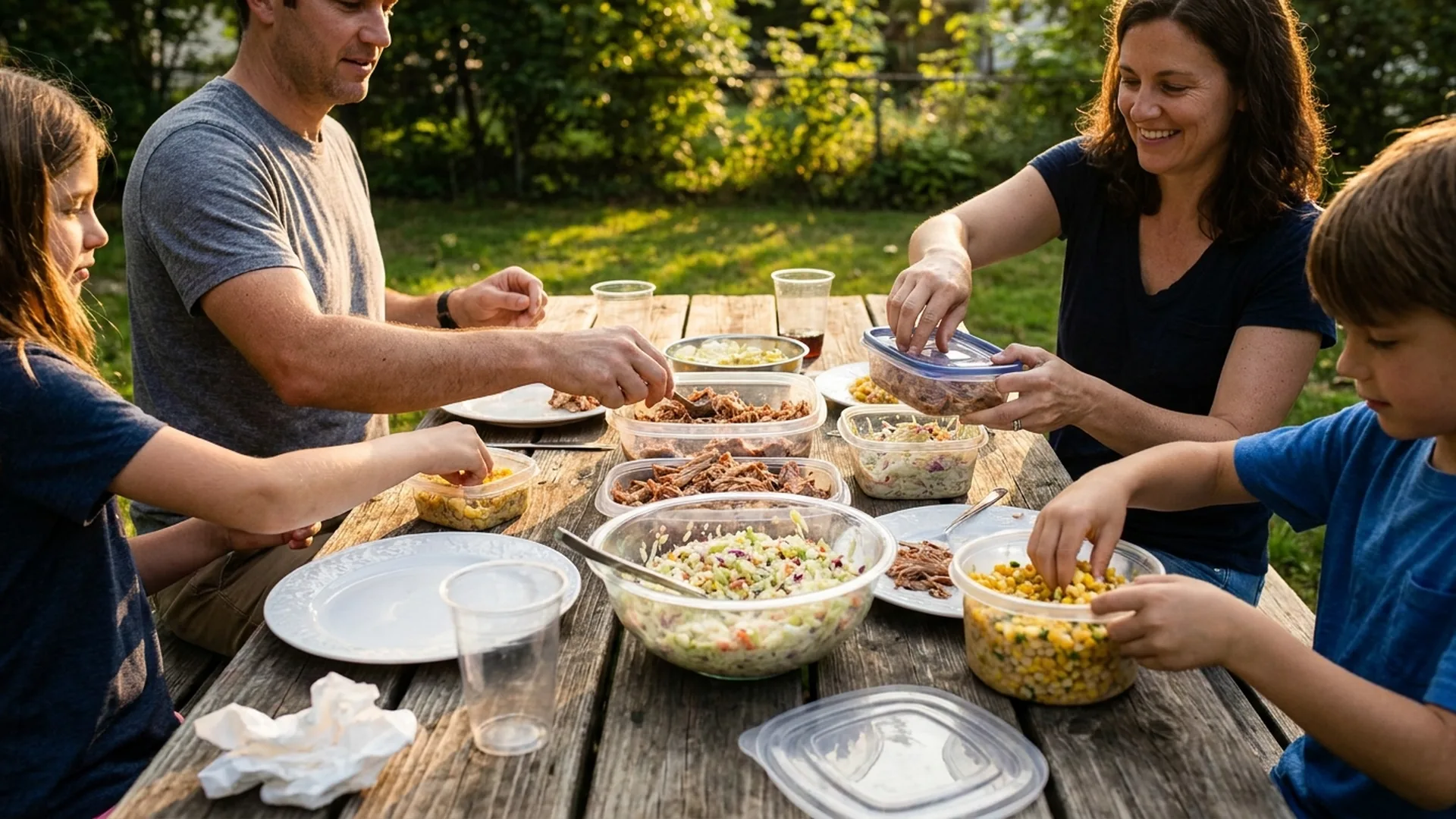
Leftovers that stayed under the 2-hour rule (or 1-hour above 90°F) can be refrigerated within that same window and eaten within 3-4 days (USDA FSIS, Leftovers and Food Safety). Anything that sat out longer than the rule should be discarded, even if it looks and smells fine. Bacteria that cause foodborne illness do not always change food’s appearance, smell, or taste (FDA).
Reheating Rules
- Reheat all leftovers to 165°F internal before serving (use a food thermometer, not eyeballs)
- Only reheat once and never warm the same leftover twice
- Sauces and gravies should come to a rolling boil before serving
- Cold leftovers (fruit, cheese) should stay cold from fridge to plate, no warm-up window
Personal experience
Every summer we get called back after big parties to check on leftovers a client is unsure about. The rule we tell them: if you cannot answer “when did this dish come out of the caterer’s container?” with certainty, discard it. The cost of one wasted tray is trivial compared to a single hospital visit.
Planning a Catered Summer Party in Central Minnesota?
Lily’s Wings Catering delivers hot-hold chafing dishes and cold-hold service across St. Cloud, Sartell, Sauk Rapids, and Central Minnesota. Wings, pulled pork, classic sides, drop-off from $15 per person.
Lily’s Wings Burgers & Things · 1970 Sandstone Lp S, Sartell, MN 56377
Frequently Asked Questions
How Long Can Catered Food Sit Out at an Outdoor Party?
Perishable catered food is safe out for 2 hours at temperatures under 90°F, and just 1 hour when it is above 90°F, per USDA FSIS. The clock starts when the food leaves an insulated container or refrigerator. Cornbread, rolls, chips, whole fruit, and dry desserts can sit out longer because they are non-perishable.
What Is the Danger Zone for Food Temperature?
The Danger Zone is 40°F to 140°F, the range where foodborne bacteria multiply fastest per USDA FSIS. Keep hot foods above 140°F using chafing dishes or slow cookers, and cold foods below 40°F using ice bowls or coolers. Bacteria can double in as little as 20 minutes inside the Danger Zone, so timing matters as much as temperature.
Is Mayonnaise-Based Food Dangerous at Outdoor Parties?
Commercial mayonnaise itself is acidic and relatively stable. The real risk in a mayo-based salad is the protein mixed in (chicken, egg, pasta) that needs to stay cold. Treat any mayo-based salad as high-risk, but the mayo is rarely the source. Eggs and poultry are the more common Salmonella carriers, and Salmonella topped every pathogen in solved 2024 multistate outbreaks (CDC).
Can I Put Catered Leftovers Back in the Fridge After a Party?
Yes, if they stayed within the 2-hour rule (or 1 hour above 90°F). Refrigerate within that window and eat within 3-4 days, reheating to 165°F internal before serving. If food sat out longer than the rule, throw it out even if it looks fine. Bacteria that cause illness do not always change food’s appearance, smell, or taste (FDA).
What Is the Safest Way to Keep Hot Catered Food Hot at an Outdoor Buffet?
Chafing dishes with sterno cans underneath are the gold standard. They keep food at or above the required 140°F for about 2 hours per sterno can. Slow cookers on “warm” and insulated food carriers work for smaller quantities. Avoid aluminum foil trays without a heat source and oven-warmed platters left uninsulated at the buffet.